
Admin key in DeFi, and Why Should You Care?
Decentralized Finance (DeFi) has seen exponential growth due to its several benefits, but stories of scams and frauds are also circling in the ecosystem. Admin key in DeFi has become the biggest threat and decentralization seems a myth.


The DeFI ecosystem has seen unprecedented growth in the last couple of years. However, the number of scams in the DeFi space has also been on a continuous rise. God Mode or Admin Key in DeFi is the biggest threat to the decentralization of the whole DeFi Ecosystem. Let’s explore what it is and why it is important for you to learn.
God Mode Admin Key: What is it?
God Mode Admin Key denotes a password that grants devs complete control and access over the smart contracts of an underpinning project.
God Mode, a term often used by gamers when their character becomes invincible after applying some cheat code, is often used in the DeFi community also, which is focused on the abolition of a central controlling authority. As a result, no one should have access to or control over the finances for a project to be regarded as totally decentralized.
Let me Break it Down For you
Consider this. You're at your neighborhood bank, registering to open a new account until something within one of the documents grabs your attention. You take a closer look and are astounded by what you find. "The bank holds the ability to alter your current account at any moment," reads the fine language concealed amid the conditions and policies.
You request the operator to double-check your interpretation. They affirm that it is exactly as it appears – the bank can unilaterally empty your accounts whenever they choose. Would you create that account? No way! But surprise! – that's exactly how several DeFi projects work – using 'god mode' admin keys that can be utilized to erase your assets and modify your account balance at any moment.
Even non-coiners are aware that the crypto industry is notorious for scams and rug pulls, and that these rug pulls are usually carried out by developers employing their administrator keys to rob their clients. So, if you're looking at a project and discover that the devs have administrator rights, you should consider long and hard before investing. You may be astonished to hear that practically all meme currencies have admin keys.
Admin key in DeFi
DeFi has become a big sector of the crypto market with billions of dollars invested in it. The data from the DeFi pulse shows that almost a year ago, the Total Value Locked (TVL) in the ecosystem reached $100 billion, although, as of now, the TVL has tanked to $28.13 billion. Still, it is a big amount.
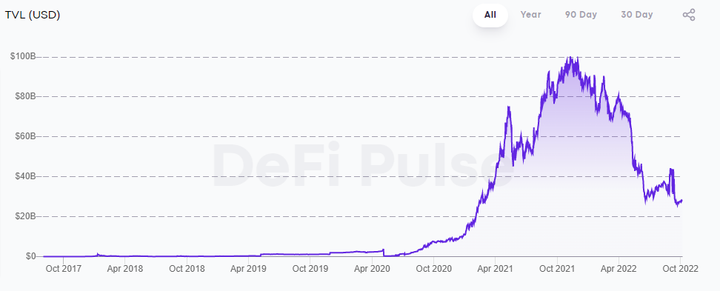
DeFiPulse
When discussing DeFi there is an inclination to attach a high level of confidence resulting from the Ethereum stability and data integrity.
The goal of an independent financial sector that is resistant to censorship, does not require faith in the intermediary, and is open-source appears to be nearer than ever before. This has encouraged cash as well as creative development teams to construct innovative products designed to dominate this growing industry.
However, achieving the goal of decentralization without making sacrifices is extremely difficult. It will be up to the community to ensure that these sites keep moving forward toward their actual objective as they develop. DeFi projects may never realize their full potential unless goals and expectations are established early.
An "administrative key" protects several DeFi services and devices that can receive deposits. This key is often an Ethereum smart contract that has the power to modify the network or product in a variety of ways.
Most administration keys are protected by mechanisms such as Timelock and Multisig. No DeFi project can demonstrate the operational security of their administrative key, as revealing it really would make it less secure. This implies that the sole option for customers to feel truly safe when using these DeFi products today is to rely on the team's experience and capacity to preserve administration keys.
Working of Timelock
A smart contract governs every interaction between the invested coins and those supplied by DeFi venues. It is feasible to set a specified delay time in the execution of any modification to the referenced smart contract by coding. The number of blocks that must pass between the contract's update and activation will represent the time. Nobody can reduce the waiting time after it is established.
This solution provides a response time in which it is conceivable to release and protect assets in the event of a sudden modification that is not agreed upon or is harmful. This is what certain ecosystem actors supply.
How can they Tweak it?
Whenever a network needs some improvements or wants to push an update, a proposal is pushed among the stakeholders to vote. At first, the main governing body decides whether this proposal is valid or not. If it is valid then the community gets to vote. If 51% or more vote in its favor, the proposal gets acceptance and is forwarded to the developers to implement it. For example, EIP-1559, a burning mechanism update, was pushed on the second-largest blockchain.
When the contract is modified, an Ethereum wallet is used, which permits executing payments and modifying chain records. To accomplish this, one security option that the project utilizes to allow for more power distribution is a Multisig.
Multiple secret keys are provided to creators or trustees, and only a certain fraction of them can access the contract. It is important to note that, regardless of what the teams proclaim, a Multisig requires trust. No one can control who receives the keys or whether they are not in the possession of a single individual, increasing the danger of fraud and theft.
Let’s Expose the DeFi Projects with the Admin key
According to the Cointelegraph, DeFi watch analyzed 15 projects back in 2020 and found out that 12 had admin keys.
Most protocols fall far short of that criterion. Only InstaDapp, MakerDAO, and Uniswap are reported to have no admin keys associated with their product among the fifteen projects assessed by DeFi Watch. The remaining projects — Aave, Compound, DDEX, Yearn Finance, Nexus Mutual, and Synthetix — all have admin keys that grant varying degrees of power.
Uniswap does not possess any administrator keys, but Glassnode, a crypto analytical business, claimed in research that the DeFi project has essentially built its own identical loophole through the circulation of their UNI governance coin.
Conclusion
Centrally controlled projects are dangerous because they contain admin keys, which allow them to suspend, relocate, or take your virtual currencies if they desire.
'Not your keys, not your coins,' you've likely heard. If not, it should be self-explanatory! When you store your cryptocurrency on an exchange or send it to a centralized yield platform, you actually give up custody of it. Is this a guarantee that you will lose your money? Of course not, but the risk is always present, and Decentralized finance (DeFi) projects are routinely attacked. Do your own research!
Discover more from CoinageReport
Subscribe to get the latest posts sent to your email.
This article is for informational purposes only and is not financial advice.


