
History of ETH: The Rise of the Ethereum Blockchain
Ethereum is an open-source service powered by blockchain technology that enables developers to build and deploy decentralized applications, using smart contracts on the Ethereum blockchain.


The second-largest cryptocurrency, Ethereum, is the ultimate platform for decentralized apps and smart contracts. Before other alternative platforms were launched, Ethereum held up to 90% of the Dapps market. Since Ethereum's inception in 2015, many other competitors such as Cosmos blockchain and Near protocol have also jumped into the arena to create different smart contract-based applications, but Ethereum is still the first choice for many developers for creating Dapps.
Ether (ETH), the native token of the Ethereum blockchain is used to pay transaction fees and other activities on this blockchain. Once speculated to cross Bitcoin's, Ether's value has seen many ups and down and currently trading at $1,861.46, second to the Bitcoin ($28,340.83).
The Crypto World Before Ethereum
Cryptocurrencies got the spotlight in 2009 when Bitcoin, the first cryptocurrency, was launched; for several years it was the only major player in the crypto market. In the early days of Bitcoin, people were excited about how it could revolutionize the traditional financial system and limit the interference of central authorities like banks and other financial institutions.
Due to insufficient knowledge about the crypto world, people were more aware of its opportunities than its limitations. But as individuals became more familiar with how Bitcoin functions, they also began to consider alternative options.
There were lots of other cryptocurrencies that were launched before Ethereum such as Litecoin, Namecoin, and Ripple. However, the main goal of these cryptocurrencies was to serve as alternative digital currency rather than as a foundation for decentralized apps.
Vitalik Buterin capitalized on these opportunities and decided to bring the next big thing in the crypto sphere, the Ethereum blockchain.
Ethereum Blockchain's Early Days
Like all other projects, the Ethereum blockchain started with an idea, and Vitalik Buterin, a Russian-Canadian computer programmer, was the man who put this idea into reality. In 2013, when he was just 19 years old, he published a whitepaper explaining the Ethereum blockchain idea as “a next-generation smart contract and decentralized application platform.”
After his idea received recognition and its potential was realized, other founding members such as Gavin Wood, Charles Hoskinson, Amir Chetrit, Anthony Di Iorio, Jeffrey Wilcke, Joseph Lubin, and Mihai Alisie joined to move the project forward.
The Ethereum project received extensive public recognition when Vitalik Buterin publicly shared the idea at a Bitcoin conference in Miami, Florida in 2014. He highlighted the shortcomings of Bitcoin as a platform for decentralized applications and how Ethereum was the perfect solution for all these limitations.
Initial Coin Offerings (ICO)
To build such a large project, generating capital was a major problem. Today, Ethereum has a market capitalization above $36 billion, when it started it didn’t have enough funds to start the project. To counter this challenge, the team decided to raise funds through Initial Coin Offerings (ICO). Through Ethereum Foundation, a Swiss-based non-profit organization, they created 60 million Ethereum for public sale and the campaign lasted for 42 days, from July 20 to September 2, 2014.
Surprisingly, they managed to sell 50 million Ethereum in the first 2 weeks and generated $18 million in Bitcoin making it the fifth most successful ICO in cryptocurrency at that time.
An additional 12 million Ethereum tokens were also created, making the total number of minted Ethereum 72 million. These additional minted tokens were allocated for marketing and other development operations. Ethereum Foundation received the remaining ETH after generating enough funds to kick-start the project.
Ethereum holders, however, were not able to move or trade their ETH as the Ethereum blockchain was still not live and they had to wait till July 30, 2015, when the Ethereum blockchain finally went up and running.
Genesis: The Birth of Ethereum Blockchain
After successful crowdfunding, Ethereum’s first developer conference was held in London in November 2015. This event lasted for two days and the purpose of this conference was to bring together developers, crypto enthusiasts, and experts to collaborate on the Ethereum blockchain. Different types of presentations, discussions, and ideas were presented to plan the development of decentralized applications on the Ethereum network.
The conference was also an opportunity for the Ethereum community to gather and share their ideas, projects, and visions for the future of blockchain technology.
Before the public release of the Ethereum blockchain, its test version “Olympic” was released in May 2015. It was essentially a test version where users were asked to run different applications, use blockchain to its full capacity, and identify any vulnerability that could compromise its future functionality. The testers were rewarded in the form of 2500 ETH as compensation for their services.
Frontier
The idea of the Ethereum blockchain came into existence on July 30, 2015, in the form of Frontier, an initial version of the Ethereum blockchain, nearly two years after the publication of the whitepaper. Ethereum’s first Genesis block was mined on this date and it marked the development of a blockchain ecosystem for decentralized applications of all kinds.
Through Frontier, 8,893 transactions that sent different amounts of ether to various addresses were included in the Genesis block, which also had a 5 ETH block reward.
The main characteristics of Frontier protocol are given below:
• Block Reward
When miners successfully validate a transaction on the Ethereum blockchain, they will be rewarded with 5 Ethereum.
• Gas
Transactions on the Ethereum Frontier network required the payment of gas fees, which are calculated based on the complexity of the transaction and the current network demand. In the early days, the gas limit was set at 5000 gas per block. However, after a few days, the gas limit was removed and the network started to function properly as originally intended.
• Ether
Ether was declared as the native token of the Ethereum blockchain to pay the gas fees and other activities on the blockchain.
• Decentralization
Ethereum was designed to provide developers with a decentralized environment where they could freely develop DApps without reliance on or interference from central authorities.
• Limited Scalability
Initially, Ethereum’s Frontier had limited scalability with the ability to process 15 transactions per second. Ethereum blockchain is now capable of processing 30 transactions per second.
Ice Age
The initial version, Frontier, was just the beginning and Ethereum had to go through a lot of changes and updates. In 2015, Ethereum introduced the difficulty bomb as a way of pressuring its community to transition from proof-of-work (PoW) to proof-of-stake (PoS). When this difficulty bomb is triggered, it will automatically increase the block time, ultimately slowing down the network after every 10,000 blocks. This mechanism would make the network freeze; hence it was subsequently termed “Ethereum’s ice age”.
In short, Ethereum’s ice age mechanism was designed to shift Ethereum from proof of work (POS) to proof of stake (POS) consensus.
Homestead
After Frontier proved a successful update and attracted the attention of investors, Ethereum decided to launch its next version, Homestead. Homestead was probably the most important update in Ethereum history and it included three major developments in Ethereum.
• First of all, it removed canary contract capabilities that were centralized but necessary for the Ethereum in early days. This step made Ethereum decentralized.
• Then it introduced new programming languages for coding.
• Lastly, mist wallets were introduced, which enabled users to hold ETH in wallets to interact with DApps.
The Homestead update also enhanced the platform with Ethereum Improvement Proposals (EIP) which are proposals for changes submitted by users, developers, etc. Homestead included three EIPs:
EIP-2:
In EIP 2, the gas cost for creating a smart contract was changed from 21,000 to 53,000 gas. It also introduced new rules and regulations for a transaction and block validation to minimize the threats of exploitation.
EIP-7:
A new opcode DELEGATECALL was introduced which focused on more efficient contract code execution.
EIP-8:
This EIP ensured that the Ethereum network remained forward-compatible with future upgrades and changes to the devp2p networking protocol.
Decentralized Autonomous Organization (DAO)
In 2016, the Decentralized Autonomous Organization was created. DAO was a system created to disperse the decision making power, management and entity ownership. DAO raised $150 million from different investors in a token sale for investing in decentralized projects. However, this success didn’t last long.
In June, less than three months after its launch, it fell prey to a crypto hack. Some anonymous hackers exploited the vulnerabilities in its code base and stole about $60 million worth of Ether. It was a huge setback for Ethereum which was still in its early phases.
In response to the attack, Ethereum founder Vitalik Buterin proposed the idea of a soft fork which didn’t work. Eventually, the Ethereum community implemented the hard fork to reverse the transactions and repay the investor [singular or plural?].
The stolen funds were indeed returned to the original wallet; however, the hard fork posed an existential threat to the Ethereum blockchain. As a result, the Ethereum blockchain split into two different blockchains- Ethereum blockchain, where stolen assets were recovered and sent back to the original wallets, and Ethereum Classic, the original one which continuously has been the target of exploitations.
Metropolis
Ethereum’s next update was metropolis and it was divided into two phases: Byzantium and Constantinople.
The Byzantium hard fork took place in October 2017 on block 4,370,000. In this phase, the block reward was reduced from 5 to 3 ETH to control the inflation on the Ethereum blockchain and to reduce the rate at which new ETH were generated. The purpose of this phase was to prepare the blockchain to shift to the Proof of Stake mechanism.
The implementation of the Constantinople phase was after ChainSecurity, an independent auditing firm, revealed some vulnerabilities that could provide a chance to hackers to steal the funds. These vulnerabilities were later patched, and in October 2018, the Constantinople update was implemented and it further reduced the block reward to 2 ETH to keep the ETH supply under control.
Serenity
Serenity or Ethereum 2.0 is the next major upgrade of the Ethereum blockchain; it is mainly focused on the transition of Ethereum from proof of work to proof of stake.
2020: The Ethereum Scalability Issues
After dealing with security vulnerabilities and hacking attacks, the classic Ethereum split, and the challenges of high gas fees, the next concern for Ethereum was the issue of scalability. According to Vitalik Buterin, Ethereum faces the blockchain trilemma just like Bitcoin. This blockchain trilemma consists of three components of a decentralized blockchain network.
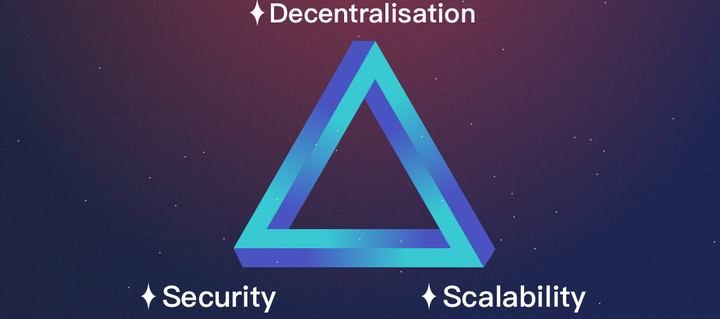
• Decentralization
Creating a blockchain where decision power is not limited to a central entity but rather is distributed to a network.
• Scalability
Scalability of blockchain is its ability to handle a large number of transactions at a time as well as increasing the number of nodes.
• Security
Security means the blockchain is well equipped with a risk management system and is able to mitigate hacks and cyber-attacks.
However, it is impossible for a blockchain to achieve all three elements in a single blockchain, so blockchains have to trade off one element to focus on other two. Thus, the blockchain trilemma makes it difficult for a blockchain to achieve perfection.
The Ethereum Merge upgrade
Considering the environmental concerns associated with Proof of work, after the Beacon Chain launched, the Ethereum development team made a number of adjustments in order to get ready for the Merge.
According to the Ethereum Foundation:
“The Merge represents the joining of the existing execution layer of Ethereum (the mainnet we use today) with its new proof-of-stake consensus layer – the Beacon Chain.”
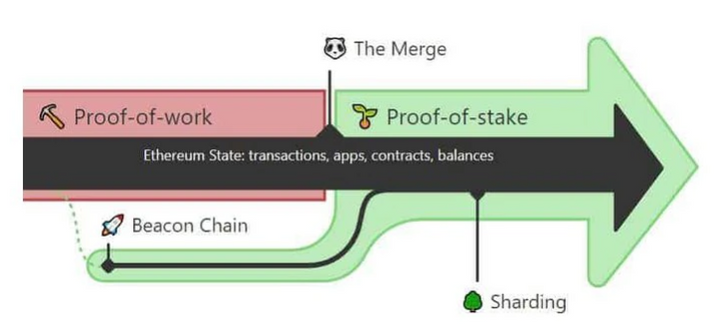
Sharding is the process of splitting the Ethereum network into multiple parts called shards to improve the scalability of the Ethereum blockchain.
Ethereum price history
Ethereum's price has seen many up and downs since its inception. In its Initial Coin offering sale, 60 million Ethereum were sold $0.30 per Ethereum. In September 2015, its price briefly rose to $2; however, soon it dropped back to $0.60.
Ethereum got enough spotlight in 2017 and the price touched the $100 mark in 2017. At the end of 2017, the price jumped to $774 and crossed $1000 in the first week of 2018. In the cryptocurrency crash of 2018, its price faced a major downtrend and decreased to just $100.
Ethereum once again rose and surpassed $4000 in 2021. Ethereum stepped into 2022 trading at $3800; however, the ETH coin price dropped sharply in the first half of 2022 despite the approach of The Merge, as cryptocurrency markets turned bearish, and traded at $1238.
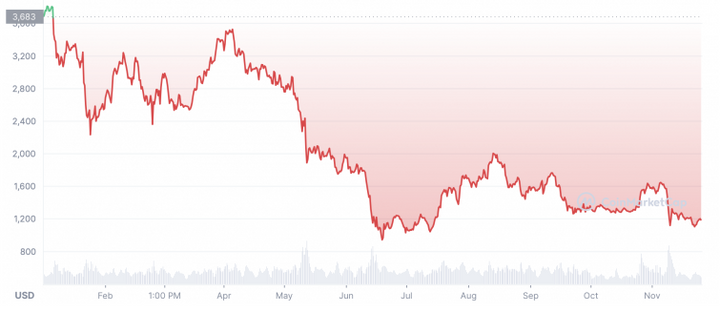
The collapse of TerraUSD stablecoin (UST) and LUNA were the main reasons behind this major downtrend.
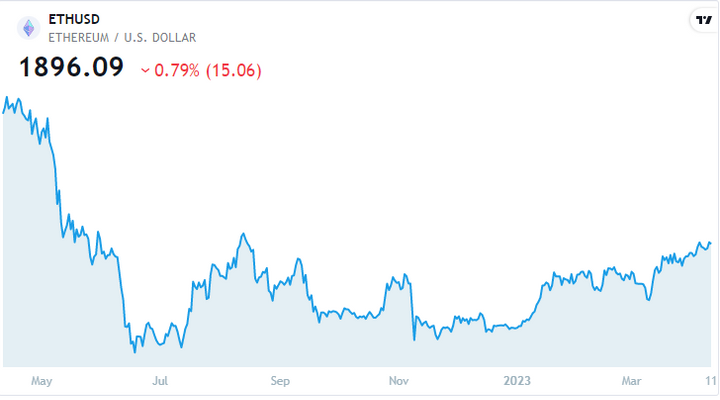
Ethereum is currently trading at $1896 with a total market cap of $228,470,070,063.
What’s Next for Ethereum
Ethereum’s new update, Ethereum 2.0 will decide the future of Ether and if it works as intended, it will further increase its utility and value. The future of the Ethereum blockchain looks promising; however, it still has to address various challenges to stay ahead of the curve.
Discover more from CoinageReport
Subscribe to get the latest posts sent to your email.
This article is for informational purposes only and is not financial advice.


