
How Current P2E Game Economy is Destined to Die?
The P2E game economy is dealing with several fundamental difficulties that could lead to its collapse in the long run.


P2E games are a relatively new type of blockchain gaming in which participants are compensated with cryptocurrencies or other digital assets for the time they spend playing the game. Unlike old free-to-play games, where players had to spend money and time and in the end get nothing, these P2E games allow players to engage in various economic activities to earn different kinds of NFTs and other digital assets which can either be used to purchase a different kind of in-game items such as armor, weapons or be exchanged for other cryptocurrencies such as Bitcoin or Ethereum.
In the old free-to-play games, we often have to spend money to enjoy the full experience of the game and we are rewarded with virtual scores and perks that are of no use to us. On the other hand, P2E games reward players with virtual currency, and tokens with can instantly be withdrawn to a private wallet or traded or exchanged on different cryptocurrency exchanges such as Binance.
Blockchain Gaming: Where it stands
The gaming industry is being shaped by P2E games. They gained popularity in the early days of 2021, and their popularity peaked at the end of the year.Morgan Stanley predicted that the total market value of metaverse technology could reach $8T, with Blockchain gaming accounting for a large portion of that.
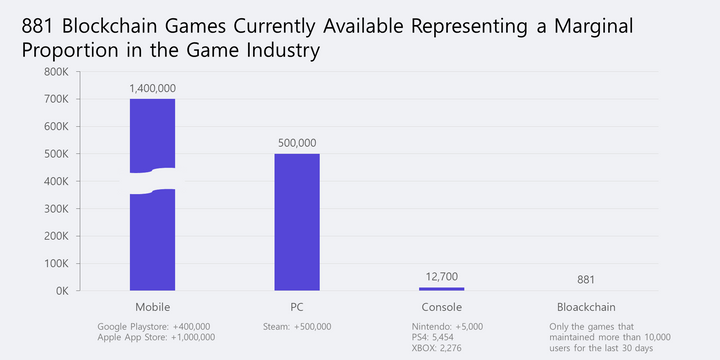
Only 881 blockchain games are available, which include mobile, PC, and console games.
Issues with P2E Games' Economy
The P2E gaming economy is facing several basic challenges that could lead to its demise in the near future. Here are some potential concerns related to the P2E games’ economy:
1. Poor Tokenomics
Balanced economies of P2E games are necessary for their sustainability and longevity.
•Imbalanced Economies
One of the primary reasons that could endanger the future of P2E gaming is imbalanced economies. To incentivize players, these games use cryptocurrencies and tokens. If these tokens are easy to obtain or difficult to spend, a surplus or shortage of these tokens results that may eventually lead to an imbalance in the game's economic system.
•Lack of player engagement
Poor tokenomics might also result in decreased player engagement. Players are less motivated to play P2E games when they believe their efforts will not be effectively rewarded due to the poor tokenomics of the games.
• Vulnerability to manipulation and exploitation
If tokens can be easily manipulated or exploited, players or hackers may employ unethical methods to obtain an unfair edge, affecting the game's legitimacy and reputation in the eyes of honest participants.
2. Dependence on cryptocurrency and volatile market
As the incentive system in P2E games is entirely based on cryptocurrencies for in-game economics, the extreme volatility of these digital currencies is a possible risk for their long-term viability. A sudden fluctuation in the value of cryptocurrencies might lead to the devaluation of assets owned by players who have already invested a significant amount of time and money in the game, resulting in less engagement by players.
Furthermore, some players are uneasy or unfamiliar with cryptocurrency usage. It may be difficult for them to obtain or use cryptocurrency.
As cryptocurrency is currently the only way of incentivizing the players, blockchain gaming should consider introducing new ways to reward the players in addition to cryptocurrency.
3. Interoperability
Interoperability refers to a blockchain's ability to communicate with other blockchains. Interoperability in blockchain gaming refers to the ability of assets or tokens owned by a player in a P2E game built on a specific blockchain to be used or transferred to the game of another blockchain. The rewards in these games are not limited just to the games; players own these assets outside of the game in their private wallets, so they should be able to use these assets or items in other games or blockchains.
Interoperability can significantly improve the gaming experience in blockchain gaming. Improved interoperability would allow players to transfer their favorite characters and armors across games without having to pay for these items on another blockchain.
In addition to the interoperability of assets, the Interoperability of experience can also play a key role in the widespread adaptation of P2E games. Interoperability of experience means the ability of players to transfer their game experience, achievement, or perks across different blockchain games.
4. Sustainability and balance issues
The PE2 game paradigm is constantly faced with difficulties of sustainability and balance. This occurs when one player accumulates a huge number of digital assets, currencies, and tokens, causing instability and inequity among other participants.
It is also tough to balance the difficulty level for different players. If the game is too easy or too complex, players may become disengaged. Since there is no way for a player to make money without making the opposite player lose, its economic model is also unstable.
5. Regulatory and legal issues
Cryptocurrency has been around for a decade, yet it still faces policy and regulatory problems. Governments and authorities try to regulate cryptocurrencies due to their independent and decentralized nature and effects on the economy. Cryptocurrencies are even illegal in some countries. Because P2E games use cryptocurrencies, they may suffer the same regulatory and legal difficulties as cryptocurrencies. If a game violates a country's specific rules, it may be permanently shut down or suffer huge fines.
6. Technological Limitations
P2E games are built on blockchain technology, which is extremely complex, making it tough for new players to adapt. As a result, if the game fails to attract new players, it will not make enough revenue and will eventually be shut down.
Potential consequences of the P2E game economy's demise
Both the blockchain gaming industry and players have already invested a lot of time and money in the platform. The global p2e gaming industry was valued at 776.9 million US dollars in 2021 The repercussions of P2E game economic collapse might be severe, both for players and the gaming industry. Here we discuss some potential consequences if the P2E gaming industry collapses.
1. Loss of value for players
The players who have already spent a great deal of time and money on the platform would suffer a great loss if the P2E gaming sector collapsed.
2. Damage to blockchain technology's reputation
The collapse of P2E gaming would be a huge loss for the blockchain technology’s reputation which is still under development and already facing numerous challenges.
3. Negative impact on the gaming industry
In addition to affecting players' confidence in blockchain gaming, the failure of P2E gaming may also make gamers less likely to play free-to-play games, which would be a big loss for the gaming industry.
Conclusion
Play-to- Earn games are all the rage these days and they are shaping the new face of the gaming industry, but to survive in the longer run, the game ecosystems must rely on sustainability instead of hype-driven short-term gains.
Increased interoperability, cross-chain engagements, and a fun-oriented gaming model can attract players. This new addition of players might increase P2E adoption and help stabilize its economy.
Discover more from CoinageReport
Subscribe to get the latest posts sent to your email.
This article is for informational purposes only and is not financial advice.


