
How to master buying the dip
Cryptocurrencies don’t move in a single direction; they keep moving between dips and highs. If you manage to buy the dip at the right price, you’ll end up making quick and huge returns from your trade.


What is ‘Buy the dip’?
Buying the dip sounds simple: pick up an asset while it’s cheap, and profit when it recovers. In practice, timing that moment is the hard part — and it’s where most people get it wrong.
No share or crypto coin rises in a straight line. There are always rises and falls. During the COVID-19 pandemic, for example, Forex, Commodities, and other shares went down, but they recovered as the COVID situation improved. Had you “bought the dip” on those shares, you’d be in profit now. The same happens in the cryptocurrency sphere: the market dips, then peaks. Bitcoin’s value reached an all-time high of $64,000 before it dipped to $28,000 last year then recovered to $69,000 in November 2021. It’s currently trading at $22,800.
So technically we’re in an extended dip which could last 2 to 3 months more. If you plan to buy Bitcoin for the long term and you buy it at the current price, you’re buying the dip.
Remember – Bitcoin has a history of always recovering. You buy the dip of the assets you believe can recover.
How can you identify the coins to buy the dip?
Go to top losers
If you already know which coin you’r going to buy, you can skip this part. Websites like Coinmarketcap and exchanges like Binance show the top gainers and losers in the last 24 hours. Head to the top loser and try to spot the cycle’s bottom to take an entry. In the image below, you can see the coins which are down even 28% in just 24 hours; you should not, however, buy every coin that is falling – there’s a lot more to consider.

Once you have picked a coin, do a fundamental analysis of it. You should check on Twitter what people’s perceptions about this coin are and find out why it’s failing so badly. If it’s just a price cycle and people (not spammers) believe it can recover, now is the time to examine it technically.
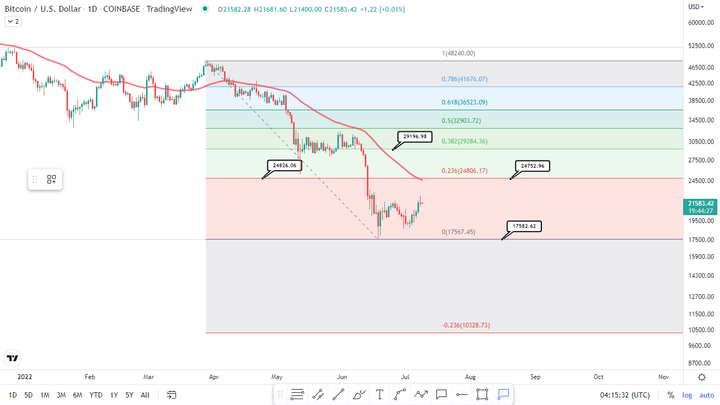
Go to Tradingview and open the chart of the coin you plan to buy. Suppose we want to buy Bitcoin; we’ll open the chart and apply indicators on it to investigate the trend technically.
A Fibonacci retracement indicator can help you find the bottoms and targets of the coin. As shown in the chart below, Bitcoin’s recent dip was near $17,500 and it has recovered to $24800, fib 0.236 on a daily chart. Also, EMA can help you find support and resistance. EMA 50 on the Bitcoin daily chart has now turned into support, and if we had bought Bitcoin already, this EMA line could be our sell-off target.
How to Buy the Dip
Now that we have spotted the entry and exit points, there are two ways to enter the trade. One is simply to go all in at the current price. However, if the price of Bitcoin further drops, we’ll be left with nothing to buy the new dip.
The second method is called ladder strategy or Dollar Cost Averaging. In this method, you subdivide your portfolio and buy in parts at different positions. For the current scenario, for example, we’ll be buying Bitcoin with 20-30% of our portfolio at the current price and then placing the orders at lower prices but always keeping at least 10% on hand to buy in the event of further dips.
Risks of buying the dip
Buying the dip comes at the cost of patience. It takes a lot of time for traders to overcome the fear caused by the market sliding down and enter the trade again. You might even have to wait weeks to see a profit. However, this is not always the case — some coins recover really fast.
The Bitcoin drop from $69,000 to $40,000 is a good reminder of the strategy’s biggest flaw: a dip can keep dipping. Buying the dip only works if you’re prepared for the possibility that today’s discount becomes tomorrow’s new normal.
Discover more from CoinageReport
Subscribe to get the latest posts sent to your email.
This article is for informational purposes only and is not financial advice.


