
What Does China Want to Achieve by a Crypto Ban?
The People's Bank of China (POBC) and other government authorities have started to crack down on crypto and have restricted crypto mining and transactions. What does China want to achieve by this crypto ban?


The People's Bank of China (PBOC) blocked all digital currencies in early September 2021. The PBOC underlined crypto assets' involvement in aiding fraudulent practices as well as their function in creating a looming threat to China's monetary sector because of their highly volatile nature.
We will explore what the main motives behind this crypto ban were and how much China has been able to achieve.
Crypto Ban in China
On September 24, 2021, ten government agencies, including the PBOC, released a unified notification clarifying that virtual currency is not an official currency. Furthermore, all bitcoin activities are banned in China, including the utilization of overseas platforms providing services to Chinese individuals. The officials warned that personnel of overseas cryptocurrency trading or firms situated in China that provide services to them will be questioned and prosecuted.
NDRC and ten other bodies released additional directives advising municipal governments on how to shut down crypto-mining activity in their regions that same day.
China has joined the increasing list of nations that have prohibited or limited the use of digital currencies. These limitations are in place in Egypt, Indonesia, Nepal, and other places.
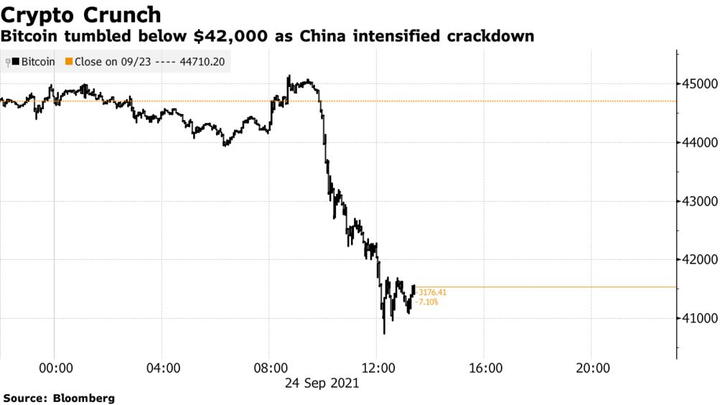
Because Beijing had one of the largest global crypto markets, fluctuations in the Chinese market influenced the worldwide value of coins. The notification of the cryptocurrency prohibition caused the bitcoin value to drop by more than US$2,000.
Bloomberg
This prohibition is part of a broader nationwide assault on monetary terms. The Chinese government regards it as a bad investment and is concerned that it will be used to commit fraud. According to the People's Bank of China, "[cryptocurrency] gravely jeopardizes the protection of people's resources."
China Has a History of Banning Crypto
The recent crypto ban in China isn’t something new, as the country has a long history of crypto bans. In 2017, the Chinese closed down domestic cryptocurrency trading platforms, even though its speculating market represented 90% of global cryptocurrency trade.
Buying and selling virtual currency was authoritatively prohibited in China in June 2019, when the PBOC announced that access to all types of bitcoin exchanges, both local and foreign, and Crowdfunding web pages would be blocked, even though digital currencies managed to continue on international trading platforms.
The recent ban on crypto assets was more severe than previous ones. Let’s see how the Chinese made this crypto ban successful.
● China barred entities and businesses from offering crypto-based solutions in May, alerting consumers about the volatile nature of cryptocurrency assets.
● Multiple professional associations published a statement emphatically stating that providing solutions such as enrollment, releasing, establishment, and investing is not permitted.
● Government officials tried to impose more pressure on the organization by informing purchasers that they would not be protected if they traded bitcoin and other virtual assets.
● In June, the government ordered payment systems and financial institutions to halt facilitating payments and banned cryptocurrency mining.
● Finally, in September, two documents were made public.
Legitimate currency and digital money transactions, purchasing or selling digital currencies (including offshore sales to Chinese nationals), and offering cryptocurrency knowledge (such as valuation and technical support) are now prohibited. They pose the risk of being investigated and prosecuted. The
government expects that by combining real and online investigations, it will be able to detect and investigate virtual currency activities.
Major banks are prohibited from supplying currencies with services such as opening bank accounts, transferring funds, and other acts that promote the usage of coins. Telecommunications companies and webpages are also prohibited from accepting cryptocurrency payments. Cryptocurrency advertisements are likewise restricted, with key terms referring to them monitored.
What were the Possible Reasons Behind this Ban?
China's prohibition indicates widespread anxiety over bitcoin. Authorities in the United States and Asia have expressed worry that virtual currencies increase risk, encourage criminality, hurt consumers, and undermine state control over financial markets.
According to the Chinese authorities, the cryptocurrency exchange has also increased betting, theft, financial fraud, Ponzi schemes, and other illicit activities. Hence, the cryptocurrency prohibition is required to ensure economic cohesion and public safety.
Some observers believe that China regards virtual currencies as a danger to the digitized yuan, a virtual currency under advanced pilot testing. The Chinese People's Bank intends to be the very first global banking system to create virtual money. Whereas the PBOC's rivals in the Western countries have been more conservative, trials have been held in several large regions, including Shenzhen, Chengdu, Shanghai, and Hangzhou.
The advantages of using a virtual currency are numerous. As more operations are conducted using centralized digital money, the administration acquires greater influence over the business and its citizens.
The deployment is also considered part of Beijing's effort to undermine the United States dollar's authority and thus the influence of the United States administration in Dc. China hopes that by broadening the yuan, it will be able to minimize its reliance on the dollar-dominated worldwide financial system, much as its Belt and Road Initiative is constructing an independent world trade network.
China isn’t Ready to Let go of its Control
As part of its existing stringent capital outflows, China imposes an annual limit of $50,000 on the acquisition of foreign currency. As a result, the capital outflow enabled by bitcoin is particularly noteworthy.
Earlier, the wealthy in China avoided banking regulations by buying foreign property, inventing clever accounting for global trade, and even forcing their workers to wire funds to bank accounts located abroad. Citizens in China can now buy overseas assets more simply and without the inspection of Chinese authorities thanks to Bitcoin. Because BTC and many other cryptocurrencies are decentralized, they can be utilized to avoid banking regulations significantly more effectively than traditional currency exchanges that employ the financial system.
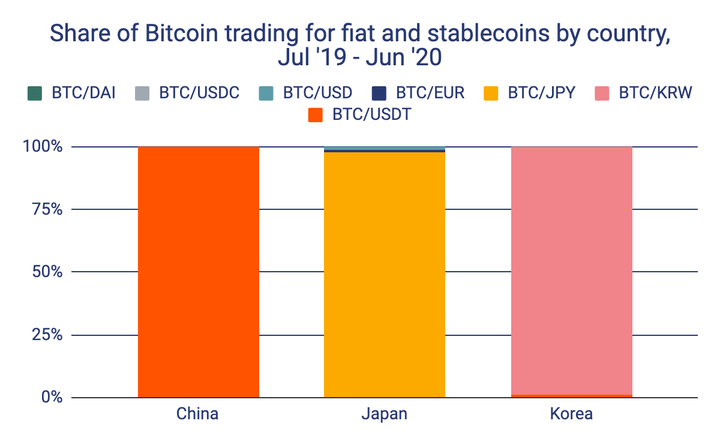
A Chainalysis report observes that Tether (USDT), a currency nominally tethered to the American dollar, facilitates a significant portion of capital outflows from East Asia. Tether gained popularity in 2017 as a result of the PBOC's limitations on crypto exchanges in China. Acquiring Crypto for USDT was already banned by the PBOC's 2017 regulation on virtual currencies, but Chinese cryptocurrency traders could still obtain Tether through discreet transactions with over-the-counter dealers or using overseas financial institutions.
Tether is extremely popular in China, according to former Grayscale Director of Research Philip Bonello, since its value is constant due to being conceptually tied to the US Dollar, making it easy to swap for fiat currency.
Source: kaiko
Overall, there is substantial proof that the crypto ban was implemented in reaction to the growing issue of capital outflows from China. Given the massive amount of cash outflow that has already occurred via bitcoin exchanges, the PBOC must have been aware that cryptocurrency was compounding China's persistent capital outflows problem.
China's national welfare initiative aims to decrease capital outflows and promote the domestic rotation of people's resources. China's goals of redistribution of wealth would be significantly more difficult to achieve if the wealthy used foreign cryptocurrency trading platforms to avoid China's already severe banking regulations and purchase international assets.
Conclusion
Because of past restrictions in place in China, many businesses and investors expected the current suspension of all digital currencies and related products and services. While asset values and digital money values first fell, they have now recovered. Because of the widespread acceptance of virtual
currencies by businesses worldwide, some believe that currencies such as bitcoin will keep rising gradually.
Firms that were formerly located in China have relocated their operations overseas to maintain operations as they shut account information with Chinese users, who are now subject to prosecution for continuing their dealings in crypto.
Discover more from CoinageReport
Subscribe to get the latest posts sent to your email.
This article is for informational purposes only and is not financial advice.


