
What is impermanent loss and how to avoid it?
Impermanent loss occurs when the price of the assets you deposited in the liquidity pool to gain rewards changes in value.


Impermanent loss refers to the value loss that liquidity providers suffer in a decentralized exchange (DEX) when providing liquidity with fluctuating prices. When the price of an asset fluctuates in a liquidity pool, it results in a loss of value for the liquidity providers compared to simply holding the assets.
Impermanent loss is referred to as “impermanent” because it can be reversed when the price of that asset changes.
Let’s say an investor provides equal amounts of Ethereum and DAI in a liquidity pool. At the time of the deposit, the value of 1 Ethereum is equal to 100 DAI. It means that the total value of the investor’s assets is 200 USD. In addition to your investment, there are assets in the pool by other investors, and the total value of the assets in the pool is 2000 USD, making you the owner of 10% of total shares in the liquidity pool. When you will decide to withdraw, a transaction fee (let’s say 0.3%) of all the transactions is your profit.
Impermanent loss happens due to the fluctuation of an asset’s price. Let’s suppose, the price of Ethereum increases and reaches 400 DAI. As the Ethereum price has increased, the ratio of each asset has also changed and there are 5 Ethereum and 2000 DAI in the pool.
If the investor had held onto his tokens, he would have had:
1 ETH x 100 DAI/ETH + 100 DAI = 200 DAI
Investor’s share of the pool as Ethereum increases to 400 DAI is:
1 ETH x 400 DAI/ETH + 100 DAI = 500 DAI
The impermanent loss investor has suffered is:
200 DAI – 500 DAI = -300 DAI
Therefore, the investor has suffered an impermanent loss of 300 DAI.

When does impermanent loss happen?
Impermanent loss occurs in various conditions in the crypto space.
I. Volatile market condition:
In a highly volatile market when the price of an asset suddenly fluctuates, there are more chances of impermanent loss.
II. High trading volume:
High trading volume disturbs the relative prices of both assets, leading to an impermanent loss.
III. Asset correlation:
If there is a correlation between the prices of both assets, there are fewer chances of impermanent loss. However, if this correlation breaks, liquidity providers may experience impermanent loss.
IV. Concentrated liquidity:
If a single investor holds a significant share of total liquidity, his or her actions might fluctuate in price sharply, causing impermanent loss.
V. Unbalanced token pairing:
When two tokens are not properly paired and one token has a different market capitalization, the chances of impermanent loss increase.
How to calculate impermanent loss:
Impermanent loss occurs due to the difference between the price of the token in the liquidity pool and the market. Calculating impermanent loss helps investors to understand the potential risks associated with providing liquidity and thus make informed decisions.
The most common and widely used method of calculating impermanent loss is the constant product formula, popularized by Uniswap. The formula is:
x * y = k
where x and y are the number of tokens indicating that the total value of the pool remains constant regardless of the price fluctuations of both assets.
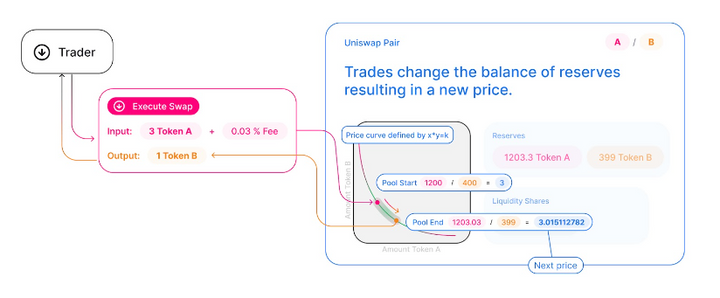
In this Uniswap example, Token B's value drops to 399 from 400 as a result of Token A's price rising from 1,200 to 1,203.03. As we all know, when the price of one asset rises, the price of the other falls. After transaction fees, the liquidity shares have a value of 3.015 USD.
How to avoid impermanent loss
In a liquidity pool, you deposit your crypto assets to gain rewards against them ; it is a lucrative method of generating passive income in the cryptocurrency space. However, dealing with assets like cryptocurrency is not short of risks such as an impermanent loss. Although you can’t avoid it completely, here are some ways to mitigate this loss significantly.
I. Choose protocols with Impermanent Loss Protection
Impermanent Loss Protection is a tool offered by some DeFi protocols to protect liquidity providers from suffering impermanent loss. It is important to remember that these platforms do not guarantee 100% loss compensation on the first day. They offer 1% protection each day, which means you have to keep your deposits in the liquidity pool for a minimum of 100 days to be fully compensated for the impermanent loss.
II. Use only low-volatility trading pairs
Choosing less volatile pairs is a great strategy to minimize the risk of impermanent loss. Pools with stablecoins like USDT and DAI tend to experience less risk due to the low volatility of these coins as their value is always equivalent to the price of USD.
As impermanent loss is always associated with the volatility of cryptocurrencies, choosing low volatility trading pairs significantly minimizes the chances of facing impermanent loss.
III. Adjust the liquidity by monitoring market
Changing the liquidity of assets in the liquidity pool according to the market situation is another method of mitigating impermanent loss. For example, if investors notice an upward or downward movement in the price of an asset, they can adjust the liquidity accordingly to capture gains.
IV. Use multiple liquidity pools
Contributing to multiple liquidity pools not only diversifies your portfolio but also spreads the risks and also avoids exposure to impermanent loss in any single liquidity pool. Some liquidity pools have more than two digital assets and do not require a 50:50 asset ratio. These pools, however, are more complex and require a thorough understanding of DeFi.
Conclusion:
Considering the volatile nature of the cryptocurrencies, every investor who wants to invest in liquidity pools should be aware of Impermanent loss. The value of an investment may change significantly in a highly fluctuating market, resulting in impermanent loss. However, users can avoid or mitigate this impermanent loss by due diligence and making sound investment decisions.
Discover more from CoinageReport
Subscribe to get the latest posts sent to your email.
This article is for informational purposes only and is not financial advice.


