
What is MimbleWimble and How Does it Preserve Privacy?
In the Harry Potter books series, Mimblewimble is a tongue-tying spell. The protocol of this name offers a framework for the blockchain that allows new potential for privacy, fungibility, scalability, and crypto anonymity.


Mimblewimble (MW) is a privacy-oriented technology that increases the security and scalability of cryptocurrencies. WB uses the main architecture of the digital assets, removes script from them, and encrypts it as confidential transactions.
This protocol allows users to remain completely anonymous while dealing with digital assets. This protocol is a 1800 shift from the flagship currency’s pseudonymity where the amount of crypto, sender’s address, and receivers’ address are visible to everyone. We will explore the problems it has solved and how it has solved them.
What Was the Need?
Highly skilled attackers see cryptocurrency protocols as valuable targets because such protocols deal with virtual money. In the last several years, the crypto realm has seen many attacks that caused irreparable losses of money and credibility. Presently, the current financial system has deteriorated still further, so the role of virtual money is crucial. Consequently, the security and confidentiality of virtual money have become very critical.
For example, if a company decides to provide a salary in cryptocurrency and one of the recipients decides to check the outflow of the salary through the company’s address, that recipient can check the holdings, savings, earnings, and even purchases of a co-worker. Employees’ privacy will thus be compromised.
The crypto community has been exploring many approaches, techniques, methods, and development practices that can help to reduce the chances of attacks on cryptocurrencies. Crypto enthusiasts are showing interest in using formal methods for software implementation. However, that community is also not safe from such attacks.
MimbleWimble Offers a Solution
Mimblewimble is offering a solution to all such problems providing no access to the transaction history of anyone. Until now banking systems had the upper hand in the context of information about any individual’s financial privacy. On August 1, 2016, a pseudonymous author, Tom Elvis Jedusor, proposed MW to the Bitcoin-wizard IRC channel.
Many researchers and engineers have done a lot on this concept. A talented researcher and developer from Blockstream, Andrew Poelstra, contributed a lot by solidifying the original idea and offering a security argument.
Litecoin has offered this protocol to its users. In an announcement, David Burket (the lead developer behind the Mimblewimble upgrade) confirmed that the Mimblewimble extension block (WMEB) is now available as an RC. WMEB is like a parallel highway in which the main network of Litecoin and Extension Block will be running next to each other.
Users have the option to choose either the main network for the transaction or WMEB. Users can continue to make transactions on the Litecoin main chain without jumping over to the MWEB and vice versa.
Mimblewimble vs Bitcoin:
Bitcoin blockchain contains the data from the start of the first block, meaning that anyone can download and verify its public history transaction by transaction. On the other hand, WM keeps only the essential information and provides more privacy.
Bitcoin has a scripting system that defines how transactions are structured. By removing this scripting system from a network, MW helps make it more scalable and private. The addresses can’t be traced at all and data is much smaller when compared to the Bitcoin blockchain. MW uses a cut-through feature to reduce the amount of collected data. Removing unwanted data from transactions means lower computational resources are required for WM.
Public blockchains like Bitcoin use an ECDSA signature scheme; Mimblewimble uses a standard Schnorr signature scheme (WNR18).
Working of Mimblewimble:
The WM allows the blockchain to have a more compact history which is easier and faster to download, verify, and synchronize. In an MW blockchain, there are no identifiable or reusable addresses, and data looks random to the outsider. The participants can see the transaction data. Let’s take an example.
Alice receives 10MW coins from her dad and 10 from her mom. She forwards these coins to Bob. The transactions are verified but their details are kept secret in Mimblewimble protocol. Bob knows that Alice sent him 20 coins but doesn’t know from where Alice received these coins.
So far we know that WM provides privacy and scalability but to know how it does so, let’s take a look at its working.
To understand the WimbleMimble protocol requires a clear understanding of how Bitcoin’s Unspent transaction output (UTXO) works.
A transaction contains inputs and outputs:
All inputs into a transaction must be spent.
Inputs are unspent outputs from a previous transaction.
Outputs will be unspent until they are used in a new transaction.
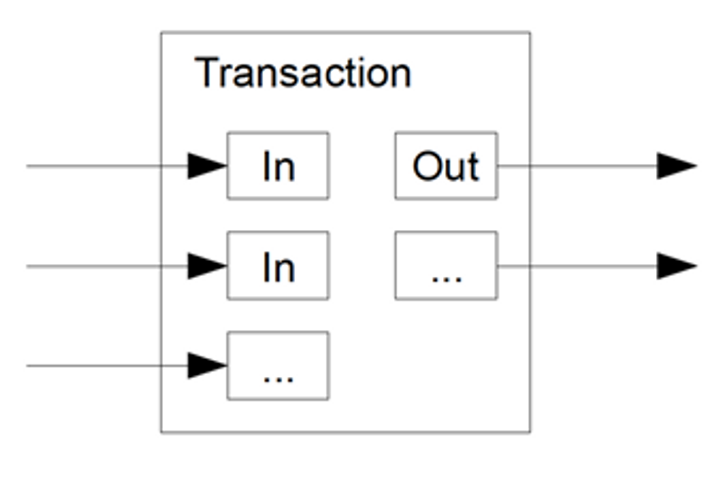
mage Source: Bitcoin Whitepaper
In the later blocks, these inputs of a transaction become spendable outputs. A node in the Bitcoin network verifies all of the previous transactions from the start of the first block in the network to synchronize with the network. This process makes the Bitcoin blockchain quite memory intensive. After this verification, the transaction is saved as historical data to verify the transactions in the future.
MW network works like Bitcoin: users can leave or join at any time in a decentralized and permissionless manner. Let’s look at a few technical terms which are necessary to understand before jumping to the next section.
- ECDSA: Elliptic Curve Digital Signature is the signature algorithm that uses keys derived from Elliptic Curve cryptography. Bitcoin and other public blockchains use this digital signature scheme.
- Payment Channel: A payment channel is a group of techniques developed to enable users to make multiple transactions without sending all of the transactions to the main blockchain.
- Script: A script can be seen as a list of instructions collected with each crypto payment. These instructions include a description of how the person at the receiving end can access the crypto being sent.
- Solidity: Solidity is the object-oriented programming (OOP) language that is used to write smart contracts.
- Generic Oracles: oracles are a way of verifying and communicating real-world data to blockchains. Smart contracts create the paths for money to move from one address to another, and oracles provide the data to confirm whether or not a condition has been met for smart contracts to be deployed for that money to move from A to B.
Confidential Transactions:
Confidential Transaction is a method that enables users to encrypt transactional data and to cryptographically verify that the inputs and outputs add up to zero without knowing the number of transactions. The miners (verifier) care only about whether the amount being transacted adds up to zero or not. Pedersen commitments allow the verifiers to verify that the transacted amount adds up to zero without any knowledge of the amount.
Coinjoin:
Gregory Maxwell was the first person to propose the Coinjoin technique which allows us to join multiple transaction inputs together and route them to their destination without any knowledge of who paid whom and how much. N users agree on uniform output size and provide inputs amounting to that size. The users after agreeing sign the transaction, which then is transmitted to the destination.
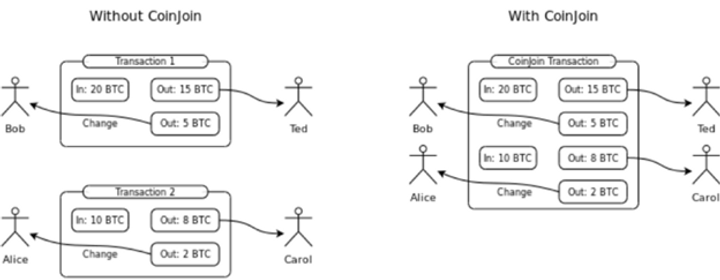
Image Source: coinjoin
This image is a true depiction of Coinjoin because everybody who is transacting has to agree with it as per protocol requirements. Consider this example: If Alice wants to make a coinjoin payment, then she can find someone who also wants to make a payment. The protocol allows them to make joint payments while concealing who paid Carol and who paid Ted.
In this example, both of the participants (Bob and Alice) have different signatures which are completely independent of each other. Coinjoin allows them to agree on a set of transactions’ inputs, set outputs to pay, separately sign transactions, then merge their signatures.
The network will require the signature of both participants; otherwise it will not consider this transaction valid. Trust in the other participant is not necessary because each side has to consent to it individually.
How do these preserve privacy?
Blockchain is nothing but a digital ledger containing historical data of transactions. Blockchains like Bitcoin and Ethereum perform transactions but expose the address of each party. Mimbewimble never reveals the details of the transaction. MW goes beyond confidential transactions and coinjoin because it contains a set of entire transactions within a block. Inputs in the MW are references to old outputs.
Actually, in the MW network, we want to verify one thing:
Sum of inputs – the sum of outputs – mining fee = kernel
The kernel is the difference between the inputs and outputs of the block; the signature is included in it. MW doesn’t make the inputs and outputs public; rather it aggregates whole transacting parties and verifies the whole sum instead of an individual signature. Thus, the signatures of the owner of every input and output are present in the block. By removing all the intermediary information, two transactions can be merged to form a new single transaction.

Image Source: Andrew Poelstra’s presentation on Mimblewimble.
Let’s consider an example to have a better understanding. Bob sends 1 coin to Alice, who forwards this to David. In the end, the result will look like Bob sent 1 coin to David. Since the network also contains the signature of Alice, this transaction can also be verified. When this idea is extended to the entire blockchain, then we can have a better understanding of what information is preserved and what is pruned away.

Source: Andrew Poelstra’s presentation on Mimblewimble.
The blockchain saves the necessary information like unspent outputs, aggregated signatures, and new currency generated. This novel Mimblewimble protocol becomes very efficient in terms of time and space when someone wants to connect with the network. Sometimes it takes days to synchronize with the Bitcoin blockchain.
Benefits of Miblewimble:
MW is a fascinating protocol that has many distinctive features. Let's analyze some of these to understand them better.
- One thing that makes MW better than other blockchain protocols is that it protects the financial privacy of the users. Users cannot track the transactions of others because this protocol provides complete anonymity.
- The second most important advantage of this protocol is fungibility. Fungibility can be understood by this example. One bitcoin token is equal to another Bitcoin in value and if one person decides to exchange one coin with another then it wouldn’t make any changes in the value of the coin. Nobody can track crypto transactions because there is no wallet address or anything related to it.
- Public blockchains have huge block sizes. This problem of block size affects the scalability of the blockchains. MW solves this problem and reduces the block size to improve the scalability.
The above-stated pros of the MW protocol make it superior to other protocols, but MW does have some cons that make the protocol a bit vulnerable. So the crypto community must work to make it better.
- The functionality of the MW protocol is affected by the lack of scripting language. The scripting language is what enables blockchains to deploy a second layer (like ETH2.0). This scripting language deficiency affects main functionality like monetary transactions.
- MW is vulnerable to quantum computing like any other protocol on this planet. Although it has never been used yet, quantum computing can be problematic in the near future.
Application:
A lot of privacy coins (like Monero, Dash, and Zcash) exist in crypto space but the underlying technology for these coins is different from the Mimblewimble protocol. Currently, there are two coins – Grin and Beam – that use MW protocol to provide anonymity to their users. We are going to look at Litecoin which has announced the launch of the MW protocol on its blockchain.
Litecoin:
Litecoin (LTC) is a currency that was launched in 2011 by a former Google engineer named Charlie Lee. The currency has faster block generation than the flagship currency, BTC, and uses scrypt as a proof-of-work (PoW) scheme.
David Burket, the project lead behind Litecoin’s Mimbelwimble Extension Block (MWEB) upgrade, confirmed that MWEB has been released by the firm. The decision of this protocol to go live will be made through the signaling process by the community. Miners can signal for the activation of the Mimblewimble protocol once the code is released completely. The firm is focusing on providing the option to the users to protect their financial information.
The firm is also determined to provide the community with sound money. The organization has compared the flagship currency and LTC with fiat and gold. The firm outlined that public blockchains coins like BTC and LTC are lacking in fungibility; fiat and gold are more fungible.

Comparison of Public blockchain assets with gold and fiat currency Source: Litecoin Foundation
Fungibility plays an important role when it comes to digital assets like LTC. Someone can argue that 1 coin of LTC is equal to 1 other coin of LTC but this might not be true in the real world. A freshly mined LTC coin is not equal to the LTC that was mined 5 years ago. The reason is that the coin which was mined 5 years ago has a history and it might have been used for illegal activities. The community labels such assets as tarnished.
People can label the whole circulation of the token as tarnished whereas only a few coins of the total supply might have been used for any illicit activity. The firm came forward with the proposal to protect the financial history of its users along with the vision to provide sound money. The firm has announced that Mimblewimble will run in parallel to the main chain of the network. Extension Block will help the users to jump in between these two chains.
Users that choose to remain on either side (Mimblewimble or Main network) will remain there. But users can shift between these two anytime they want.
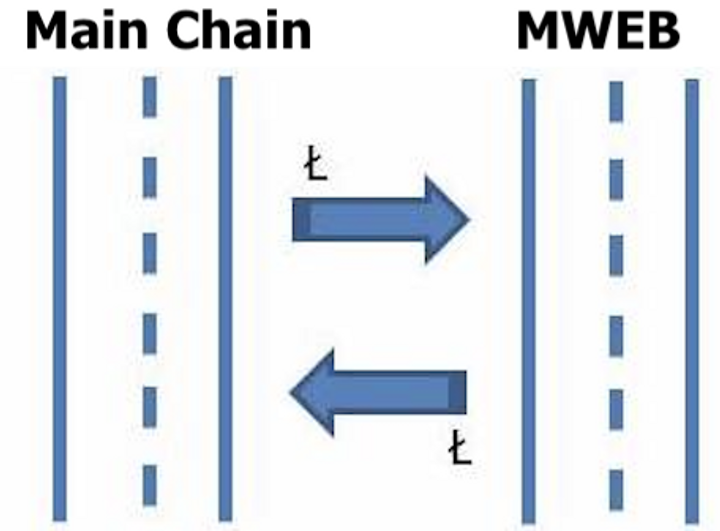
Source: Litecoin Foundation
Litecoin is using the MW protocol to provide privacy because privacy is a basic human right. Family, friends, or any third person should not be able to look at your financial history and know how much you have saved or spent. A popular Twitter account ‘Whale_alert’ tracks and publishes the amount of cryptocurrency being transferred from one address to another. To tackle such problems, Litecoin is providing a chance for its community to keep its financial history private through a highly scalable and privacy-oriented protocol.
Conclusion:
In my opinion, the implementation of the novel Mimblewimble protocol in the crypto realm will ensure its validity and capability whether it can handle a high number of transactions per second or not. It has been observed that blockchain with Confidential Transactions has more privacy but a low transaction per second rate.
Discover more from CoinageReport
Subscribe to get the latest posts sent to your email.
This article is for informational purposes only and is not financial advice.


