
What is the Ethereum Virtual Machine (EVM)?
The Ethereum Virtual Machine is the software that allows developers to build decentralized applications (DApps) on Ethereum. All Ethereum accounts and smart contracts are also stored on this virtual machine.


Bitcoin proved that money could be decentralized; the next question was obvious — what else could be? People began imagining peer-to-peer versions of everything from ride-sharing to cloud storage, cutting out the middleman entirely. Ethereum’s answer to “how do we actually build that” is the Ethereum Virtual Machine.
To accomplish this, Ethereum's decentralized network provides a DIY solution via EVM (Ethereum Virtual Machine). The network's computers function as a supercomputer, with power distributed across the nodes. By writing codes and automating the process, this Ethereum venture provides decentralized solutions. These "if-then-else" codes are known as Smart Contracts, and they are written in the Solidity programming language. In the blockchain world, code is the law, so once deployed, even developers cannot change the conditions under which it operates.
A code is typically written in plain English, such as,
If the temperature is> 30 degrees Celsius;
Turn on the air conditioning;
However, the computer does not directly understand the instructions. A compiler must convert that code into ByteCode, a language that the computer understands through the CPU. Solidity's compiler does not exist on a single computer because Smart Contracts require a decentralized network to function. So to replicate the entire Ethereum network, Solidity runs on a virtual machine that provides a virtual CPU to compile and run the program. This virtual machine is known as the Ethereum virtual machine. Smart Contract copies are distributed across the EVM network and each is run independently to produce the results.
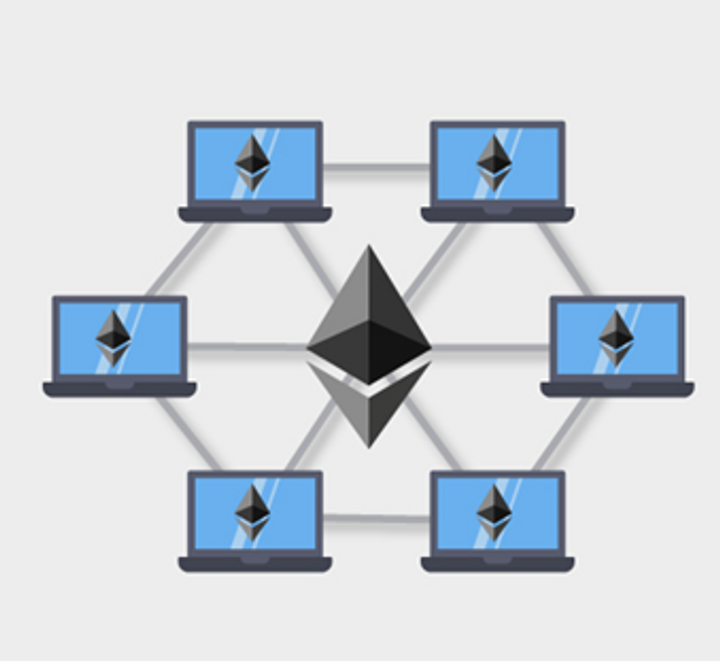
EVM assists the Ethereum network to save a lot of power and traffic that developers would otherwise consume, and it allows developers to test their Smart Contracts in even the most realistic situations without paying gas fees.
Features of Ethereum Virtual Machine (EVM)
Let’s look at the features of the EVM and how it assists the network:
- A Distributed Machine: Ethereum makes a large-scale attempt. It is much more sophisticated than a distributed ledger. The Ethereum website calls it a "distributed state machine." Ethereum stores not only account or balance data but also an entire machine state. Its machine state varies with each block, as the machine transitions with each set of programs it runs according to set rules. What factors influence these rule-based state changes? It is known as the Ethereum Virtual Machine.
- EVM is Deterministic: When a program produces the same output for the same set of inputs, it is known as deterministic. It makes no difference how many times the code is run. This is significant because decentralized apps, or dApps, on Ethereum may handle large-scale financial transactions at any given time. As a result, it is critical to understand how the code will react at each stage of execution. Determinism is essential to the Ethereum Virtual Machine's foundations.
- EVM is Isolated: Another distinguishing feature of smart contracts is that they operate in isolated environments. Two systems help with isolation: virtual machines and Docker containers. Isolation is necessary for the system to contain hacks or bugs within a smart contract. The feature is in place to ensure that such problems or incidents do not have an impact on the underlying protocol.
- EVM can be terminated: The EVM is Turing-complete: its smart contracts can solve any type of problem, at least theoretically. However, there is no way to know whether such smart contracts can complete all of the given operations within a given time frame. As a result, it is critical to include a terminating framework to create precise limits.
Which virtual machine and language a blockchain settles on says a lot about its priorities — Solidity-based chains like BNB Chain and Avalanche optimize for compatibility with Ethereum’s tooling, while Rust-based chains like Solana and Near lean into raw performance. Neither approach is objectively better; it depends on what you’re building.
Discover more from CoinageReport
Subscribe to get the latest posts sent to your email.
This article is for informational purposes only and is not financial advice.


