
Decentralized Finance: DeFi has high hopes for 2023
Decentralized Finance is predicted to reach a market cap of $1 trillion by 2023, despite having a challenging year DeFi has high hopes.


You may have noticed how often DeFi has been mentioned in the media lately. The industry has had a turbulent year, with some high-profile projects falling short of expectations. DeFi is still on target to reach a $1 trillion market by 2023, despite the setbacks.
Related Post: /web3-scammers-how-to-avoid-web3-scammers-and-phishing-attacks/
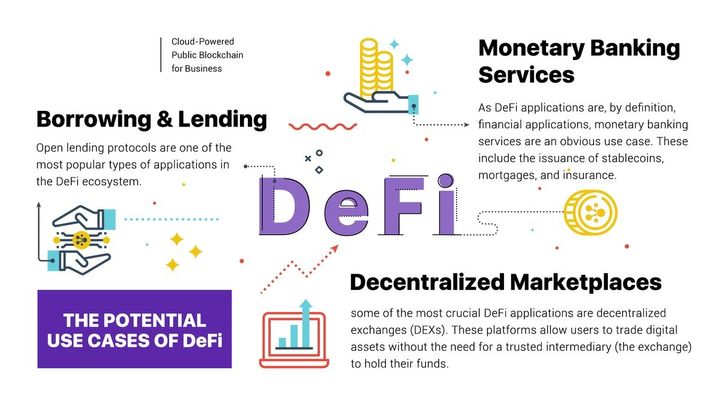
Any product or service provided by the Web3 world that allows users
to carry out financial operations including payments, borrowing, lending,
investing, trading, and staking is known as decentralized finance (DeFi).
Several Web3 use cases, like DeFi, GameFi, SocialFi, and nonfungible
currencies (NFTs) emerged during the last bullish cycle. DeFi, which had a total
peak value locked (TVL) of more than $175 billion at the height of the 2021
bull market, has had the highest market cap activity within Web3.
Why Is DeFi Increasingly Popular?
The acceptance of DeFi hasincreased as people's mistrust of centralized organizations like banks hasincreased. Users can make transactions via DeFi without being concerned aboutcensorship or seizure by outside parties.
DeFi is a segment of the bitcoin business that is expanding quickly. The
The DeFi market is expected to grow to a $9.9 billion market size by 2020. This figure is expected to increase in the
upcoming years.
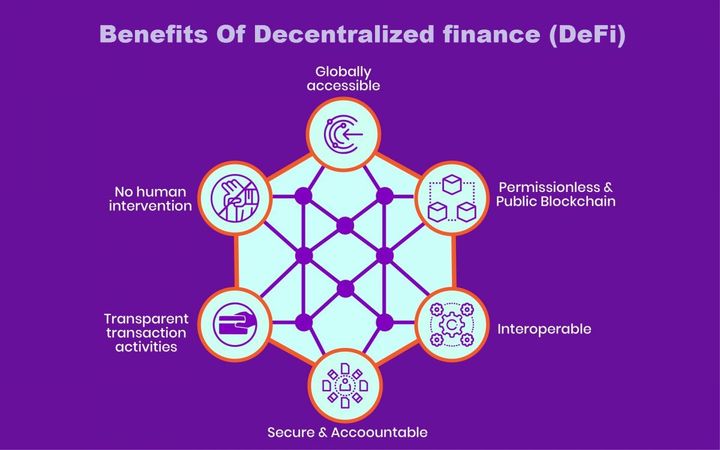
DeFi: The major use case for blockchain?
Things have changed since the creation of the Bitcoin genesis block. Following the growth of Ethereum, DeFihas experienced product market fit. DeFi TVL increased from $600 million in January 2020 to $180 billion in December 2021 during the preceding Bitcoin bull
market.
Despite the market catastrophe in 2022, the TVL under DeFi has managed to hold onto more than $39 billion. Since DeFi doesn't require a centralized entity to onboard customers, it has democratized access to financial services. DeFi has unlocked new models like automated market-making in addition to democratization.
DeFi protocols and applications have expanded due to all these novel components. Additionally, this has helped related use cases like NFTs and GameFi grow. For instance, "NFTs as collateral" lending approaches have been warmly received. DeFi-based models and markets for gaming NFTs have additionally arisen, enabling gaming guilds to access them.
Despite these intriguing prospects, DeFi's revenue in 2022 dropped to just $39 billion. Let's look at what happened in 2022 to see what DeFi can expect in 2023.

Decline from grace
2022 began with a general market decline. The Web3 network had a breach of Solana's Wormhole bridge, which led to the theft of $310 million worth of crypto assets.
They were able to escape this pit of despair thanks to a few projects on the
Solana ecology.
However, in March, skepticism about the stability of the Terra ecosystem and its algorithmic stablecoin started to surface. The network collapsed as the market continued to decline during April and May, and a sell-off in the broader market followed.
After the Terra incident, the markets bounced back over the summer until being knocked back down by the FTX fiasco. Some have observed the impact FTX and its affiliated company, Alameda, had on the ecosystem, even if the FTX scenario cannot be classed as a DeFi issue because it was the product of suspected misbehavior at a centralized exchange.
Despite the carnage, the DeFi sector has quietly continued to grow and innovate. Some institutional DeFi news from 2022 may be advantageous in the years to come.
The Lightning Network is now a foundation upon which initiatives may be built, giving the Bitcoin network some value. The Lightning Network was implemented into the Cash App to speed up Bitcoin transactions. Several other payment uses may alter the perception of the apex asset as a "store of value."
The DeFi TVL on the Ethereum network was a few hundred million dollars before the start of the previous bull run. DeFi TVLs are valued at a few hundred million dollars apiece on several layer-1 and layer-2 networks, including Avalanche, Solana, Polygon, and Arbitrum. All these ecosystems should experience DeFi growth as the subsequent Bitcoin halving approaches. The DeFi TVL right now is over $40 billion and it is expected to rise further in 2023.
DeFi and Security
In 2022, hackers went berserk, forcing DeFi crypto investors to lose substantial money. There would need to be some significant improvements in this area as laws increase and institutional adoption appears promising.
By the end of October 2022, 125 hacks had cost the cryptocurrency industry around $3 billion. Such vulnerability undermines the sector's credibility and makes it very challenging to attract institutional capital. As a result, the DeFi ecosystem has already begun developing applications that alert wallet owners to a smart contract's purposes before the user signs them.
More effort is required to address security issues related to oracles and cross-chain bridges. A positive development is the increased decentralization of cross-chain bridges. DeFi platforms will also begin taking insurance goods more seriously to safeguard user finances. Platforms running on Web3 can benefit from specialized cybersecurity products offered by firms like CertiK and Hacken.
Self-Custody and DeFi
Volumes have already started moving to DeFi platforms as a result of the failure of several notable centralized exchanges and platforms in 2022. DeFi, however, still relies heavily on centralized networks to sign up new users and perform currency conversions from fiat to cryptocurrency and vice versa. This pattern is under scrutiny and might alter in 2023.
On-ramping infrastructure into the crypto realm should advance as more people select DeFi over centralized financial systems. On-ramp plugins for wallets like MoonPay and Ramp will connect to users' bank accounts, credit cards, Apple Pay, or other payment methods to convert fiat currency to cryptocurrency and vice versa.
Wallets that do not require user management of private keys are another important on-ramp feature that has evolved. DeFi solutions can enjoy a rise in first-time users as user experience starts to take center stage.
Web 3 Gaming
Numerous gaming projects with DeFi integrations competed for market share in 2022. These initiatives will keep developing and expanding in 2023, with DeFi acting as a significant pull element.
Web3 gaming has discovered a special niche in the ecosystem and might be the growth hack Web3 has been yearning for. Staking, farming, and ecosystem-specific revenue models will offer distinctive services and value propositions that traditional games lack, even while the games still have playability issues.
How far behind could regulators be?
Central banks and authorities will start exercising more influence over DeFi as a result of significant failures by well-known enterprises and the loss of user funds.
Central banks will begin developing rules and laws for consumer protection, contrary to the principles that Web3 stands for. This area will undoubtedly be impacted in the short- to medium-term if American regulators decide to rescind the Howie Test, which has been in place for 90 years and classifies the majority of cryptocurrencies as securities.
Nevertheless, some regulation has increased the space's legitimacy. Investors may be enticed by the introduction of Know Your Customer (KYC) and Anti-Money Laundering (AML) restrictions, as well as by conducting regulations for the labeling of financial goods related to DeFi.
Institutional DeFi on the rise
Over the past year, institutional interest in DeFi has increased. Large banks and financial institutions have shown special interest in solutions for payments, custody, and AML.
Barclays invested in Copper, a company that provides institutional investors with cryptocurrency custodyservices, and Standard Chartered's innovation department teamed up with investment
management company Northern Trust to develop Zodia, a cryptocurrency custodian.
Through 2022, financial services companies like Citigroup and BlackRock will each invest over $1 billion in DeFi platforms. These companies will be forced to develop solutions to support their clients as they observe an increase in the number of institutional clients interested in the crypto asset class.
Conclusion:
In conclusion, through 2023, DeFi is expected to develop and stabilize. Any new technology has advantages and disadvantages. The time is right for sustained growth based on knowledge gathered from the experiences of 2022 after a powerful bullish phase and a painful bearish downturn.
Discover more from CoinageReport
Subscribe to get the latest posts sent to your email.
This article is for informational purposes only and is not financial advice.


