
How Blockchain Is Transforming Cross-Border Payments
The term, ‘cross-border payments’, refers to transactions across different countries, and Blockchain technology is revolutionizing the ways these payments are made.


Cross-border payments are transactions carried out utilizing blockchain technology between two businesses or individuals in two different countries. Cross-border payments are essential for the sustainability of international businesses and play a crucial role in facilitating international trade and transactions.
The Challenges of Traditional Cross-Border Payments
Making a cross-border payment through traditional payment is a complex and time-consuming process including several intermediaries, leading to delayed payment and increased transactional charges. Cross-border payments also become difficult due to high fees, lengthy processing times, currency fluctuations and security concerns. Blockchain technology, the underlying technology of cryptocurrencies, is the solution to all these problems, providing a decentralized and efficient payment method.
What is blockchain technology?
Blockchain technology is a system of interconnected computers or nodes that stores and transfers data in a decentralized, distributed and secured way. Instead of a single central authority managing or controlling the data, blockchain distributes the data over a network of computers called nodes.
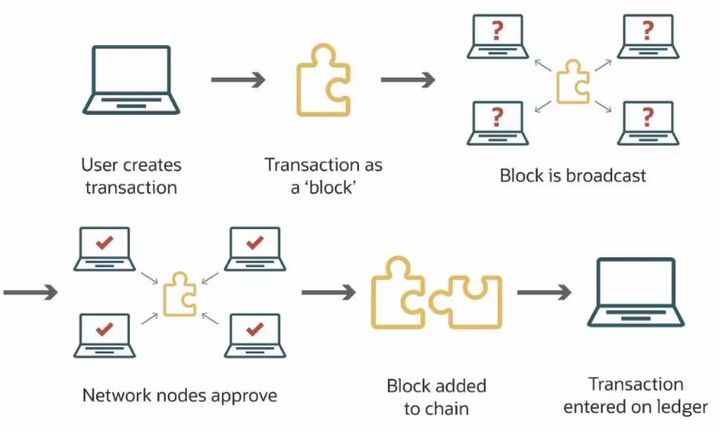
The transactions are recorded in a chain of blocks with each block connected to the one before and after it so that the data is rendered immutable. Any attempt to tamper with a block will automatically be detected by other blocks making it impossible to alter. Together, these blocks make up a blockchain.
Features of Blockchain
Blockchain technology has proven to be an ideal tool for modern businesses, tackling all the major problems in traditional payment systems. Some of the key features of the blockchain payment system are given here.
I. Non-tampered information
The immutable nature of the blockchain makes it almost impossible to alter the information as each block in the blockchain is connected to the previous one. Each block contains a cryptographic hash, transaction details and a timestamp. If anyone tries to tamper with the blockchain, the attempt will instantly be detected by other blocks in a network of nodes and it will break the consensus of the blockchain. This inherent feature of blockchain makes it a secure and reliable means for international payments.
II. Real-time Payment
Making payments through the traditional banking system involves a lot of intermediaries and takes a good deal of time. For example, an Australian company wants to make a payment to a company in China. To make the transfer possible, the Australian company will send payment to a local bank that will collaborate with a bank in China that will eventually transfer the funds to the Chinese company. Blockchain payments are a game changer for businesses that need funds quickly. Copies of the transactional ledger are distributed across a network of nodes that verify it instantly, removing the need for intermediaries to verify each transaction.
III. Decentralization
Blockchain technology is decentralized: it is not controlled by a single entity and no governments or banks are required to approve a transaction.
IV. Accessibility
Businesses working in remote regions may not have easy access to banks to make payments. In these scenarios, blockchain technology is a perfect alternative for making cross-border payments.
V. No intermediaries
Blockchain technology enables peer-to-peer transactions: the funds are directly sent from one wallet to another without third-party involvement.
How do cross-border crypto payments work?
Making a cross-border crypto payment is easy and simple as compared to the traditional cross-border payment system. For example, a person sitting in America can make a crypto payment anywhere in the world using an on-ramp service provider.
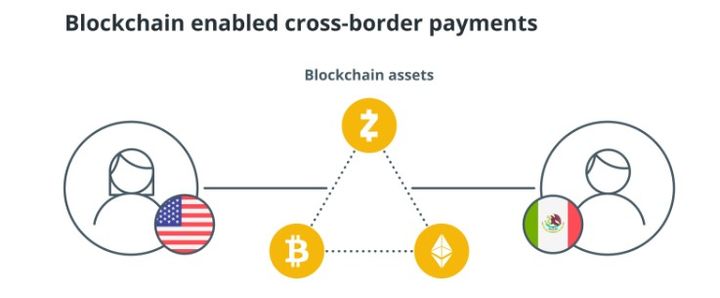
First of all, you need to convert your fiat money into cryptocurrency through the provider. This cryptocurrency is stored in a crypto wallet. If you don’t have a crypto wallet, you need to sign up for one. There are a lot of crypto wallets in the market including cold wallets, hot wallets and paper wallets. Next, you need the wallet address of the receiver. Enter the receiver's wallet address and the receiver will receive this payment in a few seconds instead of hours or even days. These crypto funds can then be turned back into fiat currency; in this way, the transaction is completed.
Challenges and risks of using blockchain technology for cross-border payments
As blockchain technology is relatively new compared to the traditional payment system, there are also certain challenges and risks associated with it.
I. Scalability
Cryptocurrency blockchains may face scalability problems when handling a high volume of transactions that results in higher processing time and gas fees.
II. Volatility
Crypto assets are highly volatile and their prices can change in a matter of a few seconds. If the receiver does not quickly convert the funds into fiat money, their value can fluctuate significantly, leading to potential loss or gains.
III. Regulatory environment
Regulatory uncertainty in the crypto space is a major problem as cryptocurrencies are relatively new technologies and there are no clear crypto-related rules and regulations.
IV. Security concerns
While blockchain technology is considered secure, there are a lot of other security challenges to be considered. Hacking of wallets, lost crypto keys, and phishing attacks may result in the loss of funds or unauthorized access to the funds.
V. User Experience
The novelty of crypto assets makes them challenging for non-technical users as most people are still not well equipped with technology. T complexity such Complex algorithms, transactional fees, and wallet addresses are some technical barriers to the widespread adoption of blockchain technology as a cross-border payment system.
Conclusion
Blockchain technology surely has the potential to change the ways cross-border payments are made. Blockchain technology reduces the number of intermediaries involved, executes real-time payments and is accessible anywhere in the world. Although there are certain challenges associated with it, it has a promising future in revolutionizing the efficiency, transparency, and security of cross-border transactions.
Discover more from CoinageReport
Subscribe to get the latest posts sent to your email.
This article is for informational purposes only and is not financial advice.


