
How to choose Blockchain Platform for your project in 2023
When choosing a blockchain platform, asking the right questions is crucial. Avoiding common pitfalls can result in a more effective outcome. Hence, asking the correct questions is important.


Blockchain technology has gained significant attention in recent years for its ability to address the challenges posed by our connected society and real-world business issues. From payments and supply chain management to secure identity verification, blockchain is being integrated into a growing number of industries. This has led to a surge in the creation of decentralized applications by businesses worldwide.
Asking the right questions is crucial in selecting a successful blockchain application.
However, the frequent changes and rapid growth in the ecosystem can make it difficult for new developers to both understand the current landscape and stay current with the latest advancements. Suboptimal solutions can result if the wrong questions are asked.
The blockchain experts at OCI possess a wealth of experience and technical knowledge in the blockchain industry, ranging from basic concepts like Merkle trees and consensus algorithms to advanced techniques like zero-knowledge proofs. To assist you, we've put together a list of four essential questions to consider when choosing a blockchain platform, encompassing the main design considerations.
Important factors to consider before choosing a blockchain platform?
1. How Much Privacy Is Needed For Your Application?
Blockchain technology comes in various forms, with some having a centralized system where a single authority manages the network and information accessible to regular users. Others are decentralized, meaning the work and data are distributed throughout the network. There are also hybrid options that involve a centralized sub chain linked to a decentralized main network.
If your application requires the sharing of confidential information like names, addresses, or business documents among users, it's advisable to avoid a purely decentralized solution as the information will be permanently visible to the public.
On the other hand, if your application aims to enhance business transparency and eliminate the need for trust, it is advisable to store the relevant data on a public blockchain for easy and verifiable access.
It is important to note that not all information for your application needs to be placed on a blockchain. You can still exchange information between peers without involving a blockchain. If it is not necessary or desirable to store the data permanently or verify it publicly, it is usually better to keep it off the blockchain.
• Protection Of Data
In some cases, users may want to demonstrate the possession of specific private information without actually sharing the data itself.
To demonstrate the existence of data without revealing it, a cryptographic hash can be used to create a unique tag for that data. Cryptographic hashes are irreversible; it is easy to use the data to generate a hash, but impossible to recreate the data from the hash. Anyone who has the data can use the same algorithm to produce the same hash, and comparing hashes can confirm that the same information is being shared.
Storing hashtags on the blockchain is an efficient and cost-effective way to inform the world that you possess a specific set of data, while still keeping the data private.
• Anonymity
Another aspect of privacy involves anonymity, where there is no way to determine which user performed a particular action. This requires a system that ensures complete anonymity.
Contrary to common misconceptions, the majority of blockchains are not completely anonymous but instead pseudonymous. This means that while it may not be straightforward to link users within the network to their real-world identities, it is possible to do so by using information obtained from external sources.
For individuals seeking true anonymity, several blockchains known as privacy chains use advanced cryptography to obscure the origin of data. Some of the most well-known privacy chains include ZCash and Monero. However, even these privacy chains can be undermined by users linking their on-chain activity to real-world actions or by multiple individuals using standard software settings.
• Additional Privacy Considerations
It's important to think about all the potential privacy risks when designing a blockchain application. To do so, it's useful to consider the following factors:
- Are the users sending transactions familiar with each other?
- Is it possible to track IP addresses through the network?
- Can a user's location be identified based on factors such as network latency or language used?
Answering these questions thoroughly can have a big impact on the design of the blockchain application.
2. How Do You Intend To Grow Your Application?
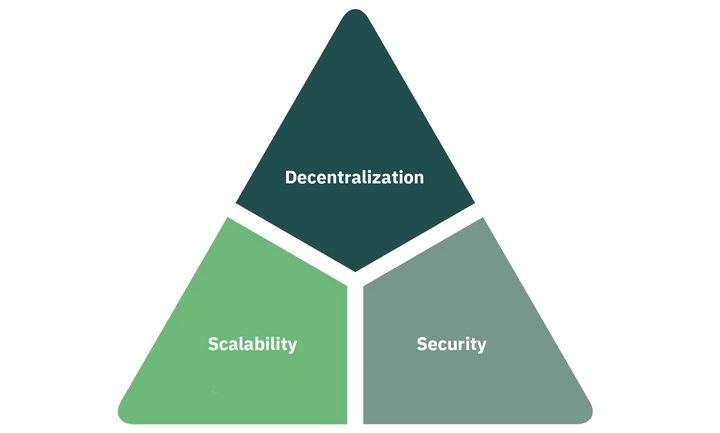
As blockchains are distributed databases that can store a wide range of information, their scalability is impacted by their decentralized nature. Scalability depends on three factors: security, speed and decentralization. Unfortunately, all three factors cannot be achieved simultaneously. This problem is called the blockchain trilemma.
As the size of a distributed system increases, it becomes challenging to gather the required information from all nodes. This results in latency and computational overhead as the system tries to route information between nodes. There is always a minimum latency that comes with any network, as the routing must be done in the correct order.
Think of network traffic as similar to regular traffic. In small towns with limited roads, the number of cars and roads is balanced.
However, with each doubling of the town's size, traffic increases by 15%. Eventually, this growth can cause traffic to reach a breaking point, resulting in frequent and unbearable traffic jams. To avoid such problems, expensive infrastructure upgrades are often required.
Similarly, increasing the number of nodes in a blockchain network can lead to a slowdown in the network.
Aside from blockchains, there are other types of distributed ledger technologies (DLTs) available that can maintain their speed or even improve it as their network expands.
One such technology is directed acyclic graphs (DAGs), which can be viewed as multiple interconnected blockchains. If your application does not require extensive use of complicated inquiries or fine-tuned permissions, a DAG may be a suitable option for you. Consider consulting with an expert in Object Computing for more information on this evolving area.
• The Number Of Nodes
Determining the number of nodes required for a blockchain network depends on the specific blockchain platform. The node, which can be a computer, cell phone, or Raspberry Pi board, must be compatible with the chosen blockchain platform and economically feasible to connect to the network.
For instance, the Bitcoin blockchain requires sufficient memory to run its node client, but running it on a small computer is economically unviable because the nodes are rewarded proportionately based on their contribution to the network's computational efforts.
Calculating the number of nodes necessary to support an application is complex and depends on various factors like network speeds, user base projections, and how the nodes will be used.
The transactions per second (tps) of a blockchain network are often touted, but this metric doesn't necessarily reflect the real-life performance of the network, which can be impacted by the usage and relative distance of the nodes.
• Quantity Of Clients
Determining the number of clients that a node can handle is a complicated calculation that depends on various factors like the chosen DLT, the consensus algorithm, the distance between nodes, the geographical distribution of users, the complexity of transactions, and the internet access speed and computer performance. The speed of the application may vary greatly between developed and emerging economies.
• More Thoughts On Scaling
When designing a distributed system, it's important to consider several factors to ensure its success.
- The location and distance between nodes and clients can impact the performance of the system.
- More complex queries can result in higher costs, longer latency, and increased computational demands.
- Additionally, privacy concerns must be taken into account, as encryption can slow down the network but enhance its security.
Finally, it's important to keep in mind that small systems may not be able to handle growth, so it's crucial to consider the speed and scalability of the application during its early stages of development to build a resilient and sustainable architecture.
3. What Role Do Digital Assets Play In Your Strategy?
People often mix up the concepts of tokenomics and cryptocurrencies with blockchain technology, but they are distinct and interrelated.
Cryptocurrencies are digital assets that operate on top of a decentralized database and have a limited supply, which prevents them from being duplicated and maintains their value. Most cryptocurrencies are built using blockchains or other decentralized ledger systems, like Directed Acyclic Graphs (DAGs).
However, the distinction between blockchains and cryptocurrencies becomes blurry when considering some blockchains serve only as a platform for a specific cryptocurrency, while others like Ethereum serve both as a store of value and a fuel for accessing computational resources on the Ethereum network.
In this case, the value of Ethereum is influenced by both market perception, similar to traditional currencies like the US dollar or euro, and its inherent functional use, similar to commodities like oil.
• Tokenomics & Consensus Algorithms
Previously, we talked about consensus protocols like proof-of-work and proof-of-stake, which outline the rules and incentives for participating in a decentralized network.
Decentralized networks are referred to as "trustless" because they rely on complex mathematics instead of trusting a single party for transactions. However, trust is still placed, but in the technology rather than the individual.
Proof-of-work consensus requires users to perform complex mathematical calculations, and the high confidence in the mathematical process eliminates the need for trust, making it low-risk for miners.
On the other hand, proof-of-stake consensus involves users staking a portion of their funds to participate in the network.
4. What Are The Accessibility Requirements For Your Application?
Software is designed to support the goals of users, and as a result, your blockchain project must be user-friendly to achieve its goals. Think about the capabilities that users need, such as exchanging tokens, launching smart contracts, or participating in decentralized governance.
• User Interfaces
DLT user interfaces are available in various forms such as web apps, mobile apps, and desktop nodes. It's important to prioritize security for end users by avoiding unencrypted data storage and limiting the distribution of private keys and seeds. This can be achieved by separating the front-end and back-end functions of the project and implementing user input validation on all forms and back-end calls.
• Web Apis
Web APIs are web-based access points to the functionalities of a blockchain project, using specific programming languages. They allow others to trigger predefined actions over the internet. Most blockchain platforms provide web APIs through the same nodes that host the ledger, and the most commonly used languages for web APIs in the blockchain industry are Javascript, Java, Python, and Go.
• Generalizable
To ensure the high usability of a blockchain project, it should be as "generalizable" as possible. The platform selected will affect the hardware requirements and potential advantage for users based on their hashing capabilities. A generalizable system should not require specialized hardware or extensive training and education to be useful.
• Data Storage
Storing complex non-blockchain data off-chain is often the best approach for blockchain platforms. This can be done on a server for application-level data or through decentralized storage systems like IPFS for better protection against malicious administration. Using IPFS enables developers to use internet addresses as references for externally stored databases.
• Geographic Availability
It's important to think about the impact of internet speeds and geographical locations on the performance and tokenomics of a blockchain application. To ensure reliability and reduce latency, it's recommended to implement data redundancy through a decentralized meshnet or well-placed cloud servers in different locations.
Conclusion
In conclusion, the potential uses of distributed ledger technology are numerous and varied. We are at the forefront of a new era in finance and organization, and while much remains unknown, the potential of blockchain technology is more apparent than ever.
The growth of distributed ledgers is poised to revolutionize various aspects of our business and civil infrastructure. Soon, our supply chains will function more efficiently and effectively, while incentive mechanisms will be greatly improved. Additionally, identities will be consistent and unalterable across digital platforms and data analysis will be carried out with unparalleled accuracy thanks to the automatic system of distributed verification.
When evaluating a distributed application or protocol, it's important to consider privacy, scale, economics, and accessibility, as discussed. This article aims to provide a better understanding of how to approach the distributed computing space and allow for a more flexible and adaptable business model, putting you ahead of the competition.
Discover more from CoinageReport
Subscribe to get the latest posts sent to your email.
This article is for informational purposes only and is not financial advice.


