
Soft Fork and Hard Fork: What Are the Differences?
Soft fork and hard fork are two different types of upgrades in blockchain that modify the protocol and consensus rules in different ways.


If you are new to the cryptocurrency world, you might have heard the term "fork" or read it somewhere and wondered what it meant. Like a fork in the road where two paths diverge, in the blockchain context, a fork represents a significant point where the blockchain splits into two separate paths and denotes a diversion from the former version of the blockchain. Developers often execute soft forks and hard forks for various reasons.
If you don’t understand what blockchain is and what soft and hard forks are, you are not alone. Here we will help you understand these complex topics in simple terms.
What is Blockchain?
Blockchain is a digital public ledger that consists of interconnected computers or nodes that store and transfer data in a decentralized, distributed and secured way. Instead of a single central authority managing or controlling the data, blockchain distributes the data over a network of computers called nodes.
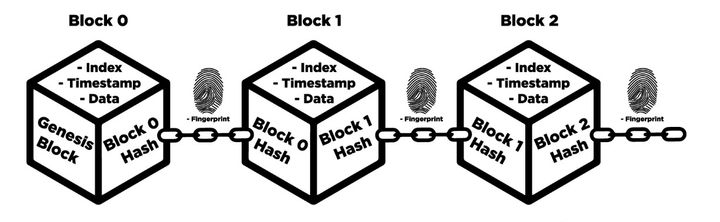
The transactions are recorded in a chain of blocks with each block connected to the one before and after it making the data immutable. If someone tries to tamper with a block, this will automatically be detected by other blocks; thus, it impossible to be altered. Together, these blocks make up a blockchain.
Features of Blockchain
Blockchain technology has proven to be an ideal tool for modern businesses, tackling all the major problems in traditional payment systems. Some of the key features of the blockchain payment system are given below.
I. Non-tampered information
The immutable nature of the blockchain makes it almost impossible to alter the information as each block in the blockchain is connected to the previous one. Each block contains a cryptographic hash, transaction details and a timestamp. If anyone tries to tamper with the blockchain, it will instantly be detected by other blocks in a network of nodes and the alteration will break the consensus of the blockchain. This inherent feature of blockchain makes it a secure and reliable means of making international payments.
II. Real-time Payment
Making payments through the traditional banking system involves a lot of intermediaries and it is a time taking process. Suppose, for example, an Australian company wants to make a payment to a company in China. To make the transfer possible, the Australian company will send payment to a local bank that will collaborate with a bank in China that will eventually transfer the funds to the Chinese company. Blockchain payments are a game changer for businesses that need funds quickly. Copies of the transactional ledger are distributed across a network of nodes that verify it instantly, removing the need for intermediaries to verify each transaction.
III. Decentralization
Blockchain technology is decentralized — it is not controlled by a single entity and no governments or banks are required to approve a transaction.
IV. Accessibility
Businesses working in remote regions may not have easy access to banks to make payments. In these scenarios, blockchain technology is a perfect alternative for making cross-border payments.
V. No intermediaries
Blockchain technology enables peer-to-peer transactions: the funds are sent directly from one wallet to another without third-party involvement.
What are Blockchain Forks and why are they important?
A blockchain fork is a change in protocols or a basic set of rules of the blockchain initiated by the blockchain community and developers to introduce new features and upgrades. In simple terms, when a blockchain splits into two, it is called a “fork”.
Blockchain forks are important for the development and improvement of the underlying protocols and rules of a blockchain.
In centralized institutions and platforms, all the development decisions are made by a central entity. On the other hand, blockchain is a fully decentralized platform without a single entity having the decision power. Rather the decision power is equally distributed among all the participants, otherwise known as miners. The responsibility of understanding the needs for the development of blockchain and executing a fork fall on the shoulders of miners and developers.
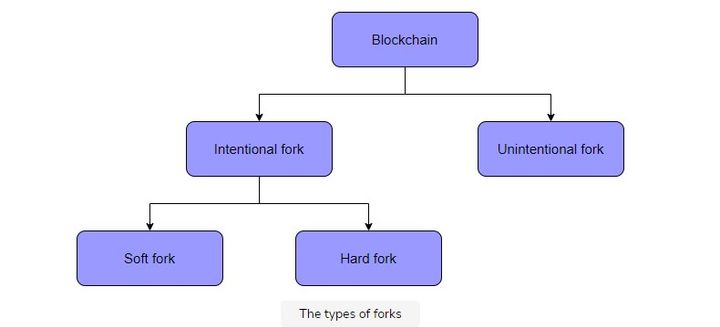
There are several types of blockchain forks. The most familiar types are soft forks, hard forks and temporary or unintentional forks.
Temporary Fork
A temporary fork, also known as an accidental fork, is a short-lived fork that comes into existence when two or more miners discover a valid block at the same time. The entire network might disagree with the choice of the block, creating a temporary divergence in the blockchain and resulting in two or more competing blockchains.
The temporary blockchain is short-lived because one of the competing chains will eventually be extended more quickly than the others, thanks to the consensus mechanism of the network, such as the longest chain rule.
As more blocks are added to the longer chain, this chain becomes the winning or dominating chain, and all other nodes agree to follow it. The other competing chain is eventually abandoned and no longer exists.
Hard fork
A hard fork is initiated when the members of the crypto community or minors who are dissatisfied with the existing rules and protocols decide to bring changes to the existing blockchain. They believe that the changes they want to bring will make the blockchain more stable and solve the challenges the current blockchain is facing. By initiating a hard fork, they generate a completely new blockchain that has its own set of rules and protocols.
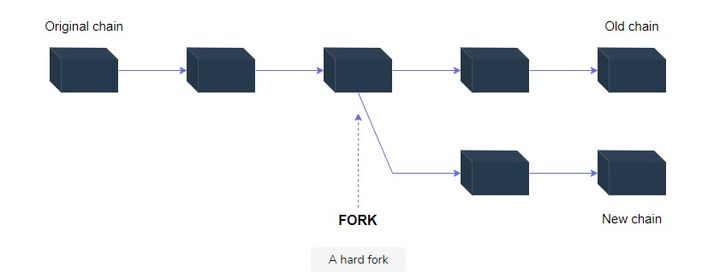
The miners who disagree with the hard fork keep on mining on the old blockchain version also known as the legacy chain. They continue to validate transactions and add blocks to the blockchain with the existing rules and protocols.
Those miners who strongly disagree with the whole hard fork idea might even choose to stop mining on the blockchain altogether or move to another blockchain that better suits their principles or preferences.
Examples of hard forks
I. Ethereum Classic and the Ethereum hard fork
In 2016, the Decentralized Autonomous Organization was created. DAO was a system created to disperse decision-making power, management, and entity ownership. DAO raised $150 million from different investors in a token sale for investing in decentralized projects. However, this success didn’t last long.
In June, less than three months after its launch, it fell prey to a crypto hack. Some anonymous hackers exploited the vulnerabilities in its code base and stole about $60 million worth of Ether. It was a huge setback for Ethereum, which was still in its early phases.
In response to the attack, Ethereum founder Vitalik Buterin proposed the idea of a soft fork which didn’t work. Eventually, the Ethereum community implemented a hard fork to reverse the transactions and repay the investor.
The stolen funds were indeed returned to the original wallet; however, the hard fork posed an existential threat to the Ethereum blockchain. As a result, the Ethereum blockchain split into two different blockchains — Ethereum blockchain, where stolen assets were recovered and sent back to the original wallets, and Ethereum Classic, the original one which continuously has been the target of exploitations.
II. The Bitcoin Cash Hard Fork
Bitcoin is the first and currently the largest cryptocurrency in the world. When people started to pay attention to Bitcoin and its utilities, its scalability and transaction speed issues also became apparent.
In June 2017, a group of developers put forward a proposal called Bitcoin ABC which focused on increasing the block size to make the blockchain more scalable. Not everyone agreed with the proposal but the hard fork was initiated anyway and as a result, a new cryptocurrency came into existence known as Bitcoin Cash. The hard fork was initiated on August 1, 2017, and Bitcoin Cash emerged as a separate and independent cryptocurrency having its own blockchain.
Bitcoin blockchain went through another hard fork in November 2018 and Bitcoin Cash and Bitcoin SV came into existence.
However, things did not end there, for in November 2020, Bitcoin Cash was forked again to create Bitcoin Cash Node (BCHN) and Bitcoin Cash ABC (BCHA).
Soft fork
A soft fork is simpler and less complex than a hard fork as it does not require all nodes to upgrade to new software for the network to remain operational and compatible. In a soft fork, the new protocol rules are backward-compatible with the existing rules and it does not generate a new blockchain. The original singular blockchain with the new protocols and rules moves forward and remains the main chain for the network.
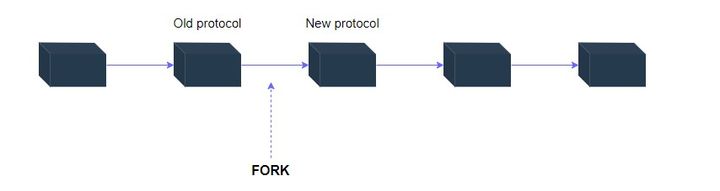
In a soft fork, nodes running the older version of the software can still operate on the network and validate transactions, even though they might not recognize or enforce the new rules introduced by the soft fork.
Example of the soft fork
Bitcoin soft forks
Bitcoin has gone through a series of soft forks since its creation in 2009. Here are some of these notable soft forks.
Segregated Witness Upgrade 2017
To increase the transactional speed and block speed, the Bitcoin blockchain underwent a soft fork in 2017.
Before the upgrade, the Bitcoin blockchain had high transactional fees and low transactional speed. Moreover, the signature information occupied more than 65% of the total size of the block, causing less processing of transactions per second. As a result, developers decided to increase the block size from 1 MB to 4 MB. Additionally, they separated the digital signature data from transaction blocks, increasing block capacity and improving transaction speed and fees.
Upgraded nodes enforced the new rules, while non-upgraded nodes continued to follow the old rules. The network maintained consensus and the original Bitcoin blockchain continued, with all transactions considered valid.
Taproot Upgrade 2021
Taproot Upgrade focused on enhancing privacy, security, and scalability by introducing new cryptographic signatures and improving compatibility with the Lightning Network, a second layer network added over the main Bitcoin blockchain.
Difference between Hard Fork and Soft Fork
I. Backward Compatibility
The concept of "backward compatibility" is one of the main differences between hard forks and soft forks. The backward compatibility of a blockchain means its ability to be compatible with older versions of the blockchain.
A soft fork is a backward-compatible upgrade to the blockchain protocol. While it follows the new rules and protocols, it does not neglect the existing ones of the older version.
On the other hand, a hard fork is a non-backward-compatible upgrade to the blockchain protocol. It introduces new rules and protocols that are not compatible with the older version. That’s why the core blockchain splits into two different blockchains: the one before the fork and the one after the fork.
II. Block Size
One main reason for executing forks is to solve scalability issues by adjusting the block size. The larger the block size is, the more information it can store, ultimately resulting in faster transaction speeds.
A soft fork does not change the block size. It remains compatible with the existing rules and generates blocks of the same size as before.
A hard fork can be executed to increase or decrease the block size. After the hard fork, those nodes that do not upgrade to the newer version may not be able to validate blocks. This can lead to compatibility issues and may result in splitting the blockchain into two parts.
III. Upgrade Process
Upgrading a blockchain by a soft fork is relatively easier than a hard fork as it involves just adding some new rules to the existing ones.
Upgrading by a hard fork is more complex as it requires all participants to follow new rules. Those nodes who disagree with the update may face compatibility issues with the main blockchain.
IV. Security
Soft forks are generally more secure as they maintain a single chain and preserve the total hash power of the network.
Hard forks are initially more vulnerable to hacks and exploitations due to the chain split. However, gradually they become more stable and secure as time passes and more nodes accept the new upgrade.
Hard forks vs. soft forks – which is better?
Both hard forks and soft fork have their own benefits and serve different purposes. Although hard fork brings significant improvements and upgrades such as increased transaction speed and scalability, they also carry risks such as the danger of potential chain splits and security concerns if the new blockchain is not widely adopted.
On the other hand, a soft fork is backward-compatible and easier to implement. However, it does not bring significant changes that might be necessary for blockchain sustainability.
So ultimately, the question of whether a hard fork or soft fork is "better" depends on the goals and requirements of the blockchain network.
Conclusion
Although soft forks and hard forks might be tough and confusing for those attached to cryptocurrencies, especially miners and developers, they are essential for a blockchain’s evolution. They play different roles in making blockchain more secure, scalable, and adaptable to meet the evolving needs of users and the industry.
Discover more from CoinageReport
Subscribe to get the latest posts sent to your email.
This article is for informational purposes only and is not financial advice.


