
Are NFTs Dead or Shifting Gears?
History repeats itself as the people searching for “Is Bitcoin dead” are now searching Are NFTs dead? Bitcoin survived all FUDs but can NFT market revive too?


The ups and downs in the valuation of goods are the price cycles
and the downtrend doesn’t mean if a good is dead or not. We all have seen big
headings on the mainstream media saying Bitcoin is dead but it has become a financial reality. The same can be the case of NFTs – or not? Let’s find out what’s been going on in the world of digital assets.
The Golden Era of NFTs:
NFTs enjoyed the limelight and insane valuation between 2020 and 2022. The story started with a Tweet selling for millions and inspired thousands of projects to follow the same projectile.
- Beeple sold his “5000 days” digital art as an NFT for a whopping $69 million.
- A unique collection of 10,000 NFTs, CryptoPunk became an ideal NFT collection with one of its NFT sold for $23.7 million.
- The NFT created by Pak and Julian Assange “The Clock” which counted the days Assange has been imprisoned was sold for over $52 million.
- Bored Ape Yacht Club NFT collection became a brand and class with NFTs with the floor price of hundreds of thousands of dollars.
NFTs peaked in January 2022 with a monthly trade volume of $4.75 billion across Opensea, Blur, and other NFT marketplaces. The trend began in July 2021 with $380 million of trade on these NFT marketplaces but the market exploded a month later as the trade volume jumped to $3.85 billion in August 2021. It slowed a bit and dropped to a low of $2.11 billion and then claimed an all-time high of $4.75 billion.
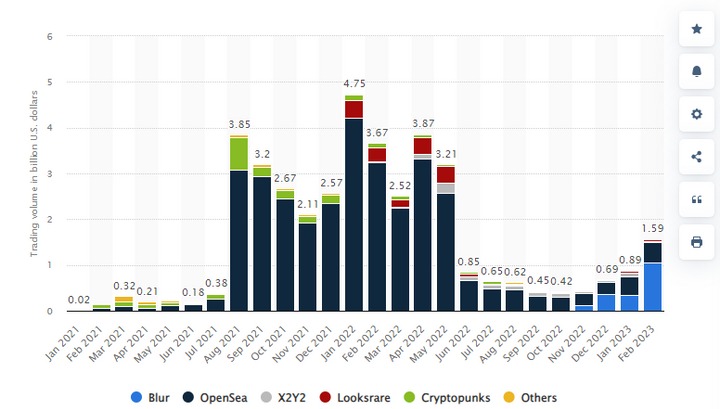
Trading volume on individual NFT platforms, including OpenSea and Blur
The concept of incentivizing the content creators and digital
artists was the real game changer. NFTs were being used as PFPs, album covers
on Spotify, domain names in Web3, building blocks in Metaverse, in-game assets in
video games, and whatnot. However, this bubble burst and now NFTs are apparently
dead.
Factors behind the NFT decline:
Lack of ‘Real’ Utility: When a few projects grabbed
the market volume, thousands of projects appeared with almost the same unreal
utilities and very few real-world applications. NFT staking, joining the
exclusive community, merch, and PFP were the most common utilities. Since these
utilities had no real use, the NFTs lost their charm.
Copy-Paste Projects: Using software to generate
thousands of digital art copies with a set trait and then offering the same
utilities as other hundreds of projects are offering, killed the NFT market.
The proliferation of low-effort NFT projects caused the dilution of value.
Market Saturation: The NFT market was a trend with
insane ROI so thousands of different NFT projects flooded the NFT market. This
increased competition made it very difficult for the NFTs to win exposure and ultimately 90 out of 100 projects died soon after their mint.
Regulatory Trends:
Regulations by the government slow down the progress and
sometimes send FUDs (Fear, Uncertainty, Doubts). This, like the traditional stocks
and crypto token prices, negatively impacts the prices of NFTs and overall
trade volume. Though NFTs comply with legal and taxation concerns of authority it
makes the adoption a challenge for these digital assets.
Crypto Bear Market: Crypto market capitalization impacts
every blockchain product. If it’s rising metaverse, web3, blockchain games, and
NFTs – all thrive and vice versa. Now that the price of Ethereum, Polygon, ADA,
BNB and Solana are more than 70%, even if the price of NFTs in terms of tokens
remains the same, they still get devalued.
An NFT of 10 ETH (when the price of 1 Ethereum was $4000) is
less valuable than an NFT worth 12 ETH (when the price of Ethereum is just
$1200).
Slowed Progress in NFT Games and Metaverse: Most NFT
projects in the roadmap promised to include P2E games or virtual space for
their community. As well as many other tokenized in-game assets and virtual
assets of metaverse as NFTs. However, both NFT games and Metaverse did not
progress at the anticipated rate so the promised utilities were never
fulfilled.
Overpromising the Utilities: NFT projects used the
successful projects as arbitrage and tried to copy their utilities and convince
the community they overpromised but could not deliver. In many cases, this over-promised
gig worked well but it eventually lost the trust of investors which triggered
the downtrend of the NFT market.
NFT: Thefts and Crimes: The unprecedented growth of
NFTs invited bad actors to steal the NFTs and this caused some key investors to
lose millions of dollars. Also, the rug pull and other scams became popular in the
NFT space and started the actual NFT winter.

NFT Thefts and Crimes: NFT Market Crash
Are NFTs Dead, Reality Check:
Opensea is the top NFT marketplace and reflects the overall
performance of the NFT market. The chart below shows the Monthly volume of NFTs
traded every month.
The Q4 of 2021 and Q1 and Q2 of 2022 were the peak days of
NFTs when the trading volume was at its peak. The trend is dying as the USD
volume is at its minimum in 2023. However, since this chart shows the trade
volume in USD and the NFTs are traded in crypto tokens like ETH and Matic, the
number of trades could be the same but the volume be lower due to the bearish market.
But that is not the case actually as the trade count is following the same
trend as USD volume.
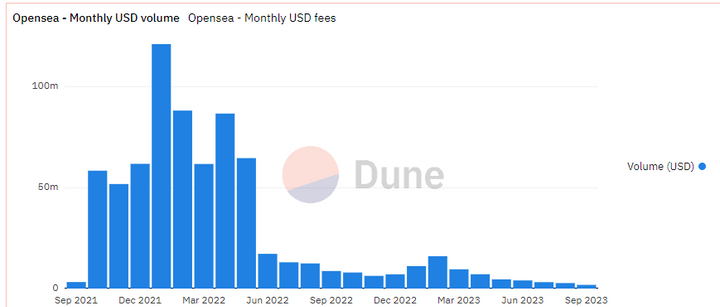
NFT Monthly Sales
This chart shows that NFTs are dead or probably dying and
might not survive till the next crypto bull run. We have discussed the reasons for
this decline already, but one prominent factor is at play causing the chaos.
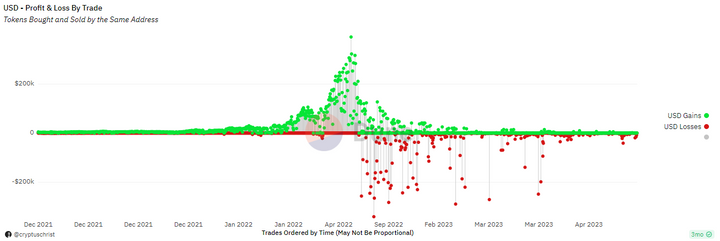
NFTs Profits and Losses: Dune
StartFragment
The green dots in the chart above show the NFTs sold in
profit and the red dots show the NFTs sold in loss by the same wallets. It is noteworthy
that, the red dots (loss) started to appear on the chart after April 2022 and
the crypto bear market began in March 2022.
Due to the devaluation of the crypto tokens, the NFT holders
had to sell their NFTs at a loss and termed the market as bearish. This all seems
to have convinced you that we are in a bearish market and NFTs are dead but
that might not be the case.
NFTs might be shifting gears:
NFTs are yet to achieve the product market fit. We all have seen
traditional NFTs of 2021 which looked like animal pictures with unreal
utilities and that is why the copycat project has died or died for good. The
speculative era of NFT valuation is over and this downtrend could be a
cleansing of the low-effort NFT projects from the market.
There are many NFT projects that are still thriving. Bored Ape
Yacht Club, Meebits, and Mutant Ape Club are some of the NFT projects with
their floor price way higher than their mint price. These are the projects that
are resilient initiatives and consistently adapt to market changes.
has lost nearly 70% of its price several times and
even now it’s over 60% down from its all-time high. For example, in 2011,
Bitcoin plunged from $32 to $2, a 93.75% decline1. In 2013, Bitcoin dropped
from $1,163 to $152, a 86.9% decline1. In 2018, Bitcoin fell from $19,783 to
$3,300, an 83.3% decline.
These are price cycles and a part of evolution which could
be the case for the NFT market too. Also, with the evolution in Web3
integration and 5G, metaverse adoption is realizing which can bring back the
golden era of NFTs.
Last but not least, as the crypto winter is over, the first crypto bullish wave will trigger the price of NFTs upwards and prove to be a resurrection
for NFTs. The growth of the crypto market cap can prove to be a potential catalyst
for NFT recovery.
Conclusion:
NFTs are dead or not – this debate depends on the
perspective of an investor. If you invested in a project that is down, you might
consider the NFTs dead. However, this doesn’t mean NFTs are dead, it’s just
your NFT that is dead. Real NFT projects are still alive and once the price of
Ethereum and other key tokens appreciate the NFT market and will gain the same momentum again.
Discover more from CoinageReport
Subscribe to get the latest posts sent to your email.
This article is for informational purposes only and is not financial advice.


